I have been a jazz buff since high school and college, accumulating a large jazz album library, I even worked as a jazz DJ for a few summers at parties. I grew up listening to my parents’ 1940s big band jazz and 1950s jazz-lounge crooner albums. My first introduction to modern jazz was when I bought the Miles Davis-John Coltrane Quintet 1950s albums and early 1960s Coltrane albums. They opened up a whole new world to me.
Coltrane was beyond description, pushing infinite boundaries in music and mixing an intricate and captivating complexity, drama, sheer energy, and soul touching beauty. I bought every Coltrane album I could find and became a devotee.
Coltrane: Iconic Jazz Legend
John Coltrane (1926-1967) tenor and soprano saxophone, bandleader, and composer, who attained a global superstar cult status. He is among the most influential and acclaimed figures in the history of jazz and 20th Century music. Coltrane helped develop the use of modes and his ‘sheets of sound’ style of rapid chord progression. He was one of the pioneers at the forefront of hard bop jazz and free jazz. He was inducted into the Grammy Hall of Fame, DownBeat Hall of Fame, and won a Pulitzer Prize.
Coltrane learned from the best, having played in the bands of three of the greatest jazz artists in history – Dizzy Gillespie, Mile Davis, and Thelonious Monk.
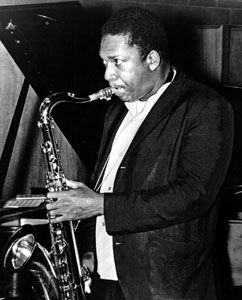
Coltrane’s Life and Career
John Coltrane grew up in North Carolina and studied music at the Ornsten School of Music. He was influenced by Lester Young, Johnny Hodges, Coleman Hawkins, Ben Webster, and Charlie Parker. During World War Two he joined the Navy and played in a Navy band. After the war he moved to Philadelphia and joined the local jazz scene. He studied music theory at the Granoff School of Music. He gained recognition and worked with the jazz bands of Jimmy Heath, Eddie Vinson, Earl Bostic, and Johnny Hodges.
Coltrane led over fifty recording sessions and appeared on many albums by other musicians. He performed with such jazz greats as Charlie Parker, Dizzy Gillespie, Red Garland, Lee Morgan, Charlie Haden, Miles Davis, Bill Evans, Cannonball Adderly, Thelonious Monk, Duke Ellington, Milt Jackson, Eric Dolphy, Johnny Hartman, Pharoah Sanders, Archie Shepp, Freddie Hubbard, Donald Byrd, Kenny Burrell, and many others. His famous Quartet with McCoy Tyner, Jimmy Garrison, and Elvin Jones was one of the greatest jazz groups in history.
Coltrane developed his “sheets of sound” style of modes by studying music theory and learning jazz techniques from Dizzy Gillespie, Miles Davis, Thelonious Monk, and Bill Evans. His modal jazz uses harmonic chord progressions to develop a specific harmony and improvization. He studied traditional Western music theory, and Indian and Arabic musical scales. Working with Thelonious Monk he learned about dissonant and angular melodic twists, sliders, runs, and unexpected chromatic notes
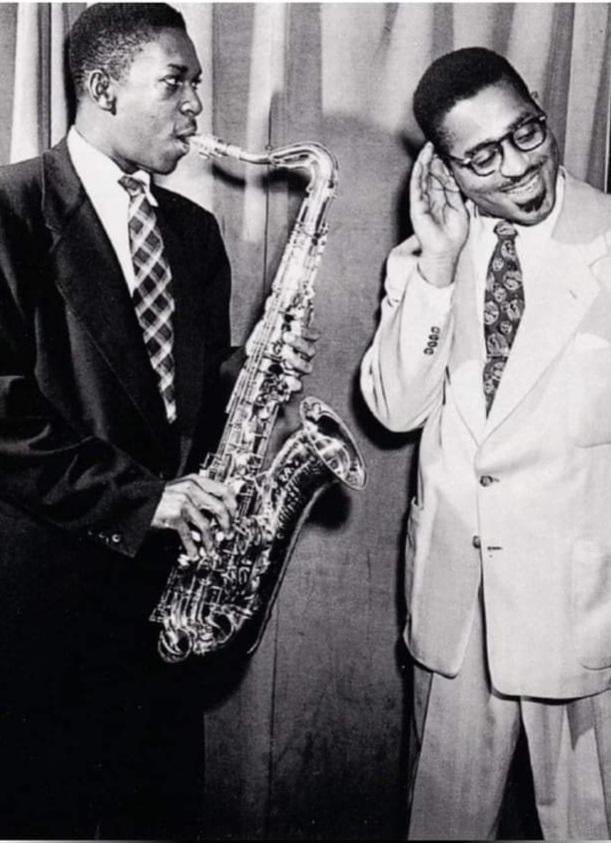
John Coltrane and Dizzy Gillespie
Dizzy Gillespie Band
Coltrane played with the Dizzy Gillespie Band in the early 1950s. Dizzy Gillespie (1917-1993) was a trumpet virtuoso Grammy winning iconic jazz legend. He pioneered bebop jazz and Afro-Cuban jazz.
Dizzy Gillespie Band with John Coltrane, 1951.
Miles Davis Quintet
From 1955 to 1960 Coltrane worked with the Miles Davis Quintet, producing 21 albums together. The Miles Davis Quintet was Davis’ first quintet, it is universally praised as one of the best jazz bands in music. It was an ‘all-stars’ hard bop and cool jazz group that made music history with some of the best jazz performances ever recorded. In 1956 the group recorded four amazing jazz albums which by all accounts are some of the best jazz recordings ever produced. The albums established Miles Davis and John Coltrane as among the top elites of jazz. They later recorded other albums, including Kind of Cool, the highest selling jazz album in history. Coltrane learned much from Davis and Bill Evans in the group. Miles Davis (1926-1991) trumpet, attained international superstar status. He is considered one of the most innovative, influential, and respected figures in the history of music. The Guardian described him as “a pioneer of 20th-century music, leading many of the key developments in the world of jazz.” (bebop, hard bop, cool jazz, jazz fusion, modal jazz).
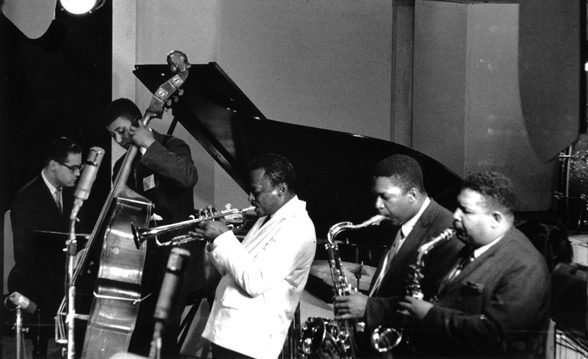
Miles Davis Quintet
Kind of Blues album
The Kind of Blue album is considered a masterpiece, called the best jazz album ever recorded. Five-times certified Platinum, it is the highest selling jazz album of all time. Highly acclaimed with accolades by Grammy, Billboard, Downbeat, Rolling Stone, National Recording Registry, and others. Rating: Allmusic 5/5, Penguin 4/4, Rolling Stone 5/5. The album was released in 1959 by Columbia Records. Bill Evans on piano was added to the group along with Miles Davis trumpet, John Coltrane tenor sax, Cannonball Adderly alto sax, Paul Chambers bass, and Johnnie Cobb on drums.
“So What” recording from Kind of Blue album. An excellent piece, wonderful ballad, classic Davis and Coltrane, a jazz standard. Composed by Miles Davis.
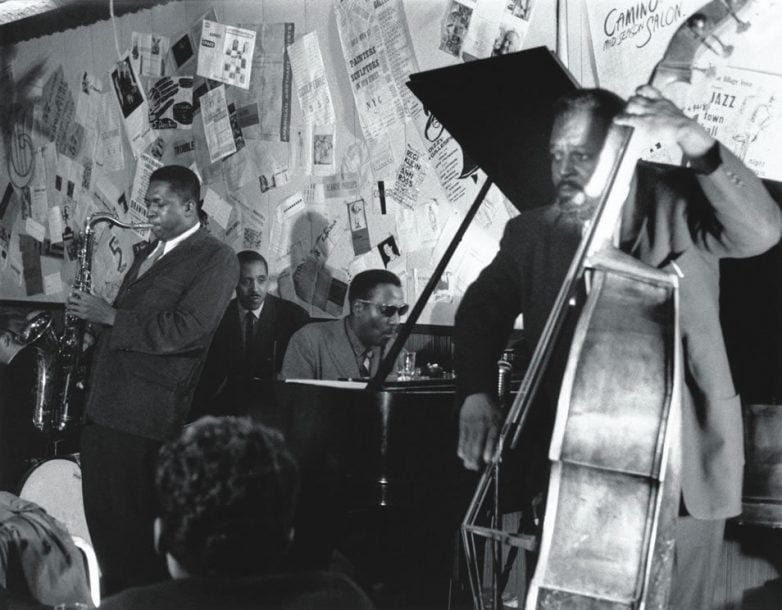
John Coltrane and Thelonious Monk
Thelonious Monk Quartet
During 1957 and 1958 Coltrane worked with the Thelonious Monk Quartet. Monk helped Coltrane develop his new style. They produced six albums together and played a concert at Carnegie Hall. Thelonious Monk (1917-1982) was an iconic bebop jazz legend with his unique improvisational style and eccentric showmanship that revolutionized jazz.
Thelonious Monk and John Coltrane at Carnegie Hall, 1957.
Red Garland Quartet
In between working with Miles Davis and Thelonious Monk, Coltrane worked with the Red Garland Quartet from 1957 to 1959. Members included Red Garland piano, John Coltrane sax, Paul Chambers bass, Art Taylor drums, and sometimes with Donald Byrd on trumpet. They recorded eight albums together. Coltrane had worked with Red Garland and Paul Chambers with the Miles Davis group.
Coltrane and Red Garland Quartet playing All Mornin’ Long, 1958.
Blue Train album
Coltrane’s first real statement of his signature style of new melodic and harmonic structures. Beautiful set with each song a gem. Very accessible to jazz newcomers.
Blue Train was released in 1958 on Blue Note records. Rankings: Gold certified, Allmusic 5/5, Penguin 4/4, Rolling Stone 5/5. Musicians: John Coltrane tenor sax, Lee Morgan trumpet, Kenny Drew piano, Curtis Fuller trombone, Paul Chamers bass, Philly Jo Jones drums.
Other tracts, all composed by Coltrane except where noted.
Moment’s Notice, Locomotion
I’m Ols Fashioned (Mercer. Kern)
Lazy Bird
Giant Steps album
A breakthrough album, Coltrane’s new exploratory and improvisational direction with his “sheets of sound” style. His “first genuinely iconic record” according to DownBeat. Excellent hard bop, straight-up jazz, clean and pure. Jazzwise stated, “Contains universal values that speak to us now of essential humanity, sheer joy of music, power, energy, moving, uplifting.” Giant Steps was released in 1960 on Atlantic Records. Rankings: Allmusic 5/5, Downbeat 5/5, Penquin 4/4, Rolling Stone 5/5. Musicians: John Coltrane tenor sax, Cedar Walton piano, Paul Chambers bass, Les Humphries drums, Tommy Flanigan piano, Art Taylor drums.
Other tracts, all composed by John Coltrane:
Cousin Mary
Countdown
Sveeda’s Song, dedicated to Coltrane’s daughter Sveeda
Naima, dedicated to Coltrane’s fist wife Naima
Mr. PC
The Classic John Coltrane Quartet
Coltrane’s 1960s quartet is legendary, with McCoy Tyner piano, Elvin Jones drums, and Jimmy Garrison bass, producing some of the best recordings in jazz history. The quartet formed in 1962 and produced 29 albums on the Impulse label, some of which were best-selling Gold and Platinum albums. The group gained international acclaim and did a successful world tour. Guest artists included Eric Dolphy, Duke Ellington, Johnny Hartman, Freddie Hubbard, and Archie Shepp.
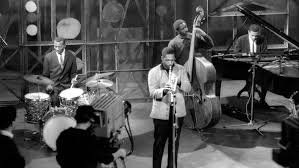
John Coltrane Quartet with McCoy Tyner, Jimmy Garrison, Elvin Jones
McCoy Tyner (1938-2020) one of the most influential jazz pianists. Tyner studied music theory and was influenced by Bud Powell and Thelonius Monk. He worked with John Coltrane Quartet from 1960 to 1966. Tyner had a successful solo career and won five Grammy awards. He worked with a who’s who of jazz.
Jimmy Garrison (1934-1976) a jazz bass player who played with many jazz artists from 1957 to 1961, including the Bill Evans Trio. He worked with the John Coltrane from 1961 to 1967. Afterward he was big in demand and played with Ornette Coleman, Archie Shepp, Sonny Rollins, and others.
Elvin Jones (1927-2004) jazz drummer who worked with Miles Davis, Charles Mingus, and Sonny Rollins. Jones worked with the John Coltrane from 1960 to 1965. Afterward he formed a band and played with big name jazz artists.
In the late 1960s Coltrane’s music took on an increasingly spiritual dimension. Very religious, he studied Plato, Aristotle, Confucious, Zen, Eastern mysticism, Hinduism, and India music. Coltrane was deeply influenced by Indian popular musician Ravi Shankar and named his son Ravi. Coltrane also became influenced with avant-garde free jazz of Ornette Coleman, Eric Dolphy, Albert Ayer, Gary Peabody, Sun Ra, Archie Shepp, and Pharoah Sanders.
In 1966, McCoy Tyner and Elvin Jones left the Quartet, dissatisfied with the shift to free jazz and Eastern mysticism. New members replaced them, Alice Coltrane piano, Rashied Ali drums, Pharoah Sanders tenor sax, along with Jimmy Garrison bass who stayed in the group.
John Coltrane died in 1967 of cancer at the age of 40 years old. He was survived by his second wife and four children. Ornette Coleman and Albert Ayer played at his funeral.
My Favorite Things album
The John Coltrane Quartet album “My Favorite Things” in 1961 on Atlantic Records is considered one of the greatest jazz albums ever produced and one of the best-selling jazz albums. Coltrane said, “It was my favorite piece of all I produced.” The album was certified Gold and inducted into the Grammy Hall of Fame. Its ratings include Allmusic 5 out of 5 stars, Rolling Stone 5 of 5, Penguin Jazz 4 of 4, as well as others.
“My Favorite Things” by the John Coltrane Quartet
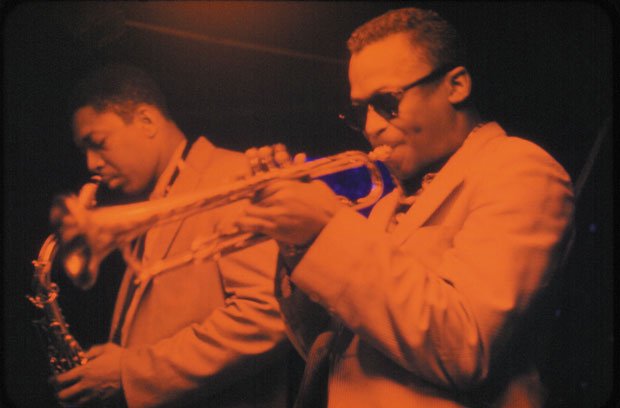
John Cotrane and Miles Davis
Live At the Village Vanguard album
A landmark performance called “the birth of sixties avant-garde jazz”. Downbeat stated: “A torrential outpouring delivered with unmistakable power, conviction, and ferocity.” Coltrane said the melody was not written, only improvisation. Released in 1961 on Impulse records. Ratings: Allmusic 4.5/5, DownBeat 3.5/5, Rolling Stone 5/5. Musicians: John Coltrane sax, McCoy Tyner piano, Jimmy Garrison bass, Elvin Jones drums, Eric Dophy bass clarinet.
Other tracts, all composed by Coltrane
Softly As In the Morning
Spiritual
Ballads album
An unexpected change of pace album with beautiful tender standard ballads and torch songs, inspirational and passionate performances. The last time Coltrane played in classical jazz style. Highly acclaimed by critics. Ballads released in 1963 on Impulse records. Rankings: Grammy Hall of Fame, Allmusic 4/5, Penguin 3.5/4, Rolling Stone 3/5. Musicians: Coltrane, Tyner, Garrison, Jones.
Classic jazz ballad from the big band era, composed by Bob Haggart.
Other tracts:
Say It Over and Over Again (Jimmy McHugh)
You Don’t Know What Love Is Gene DePaul)
Too Young to Go Steady (Jimmy McHugh)
All or Nothing At All (Arthur Altman)
I Wish I Knew (Harry Warren)
It’s Easy to Remember (Richard Rogers)
Nancy With the Laughing Face (Jimmy Van Heusen)
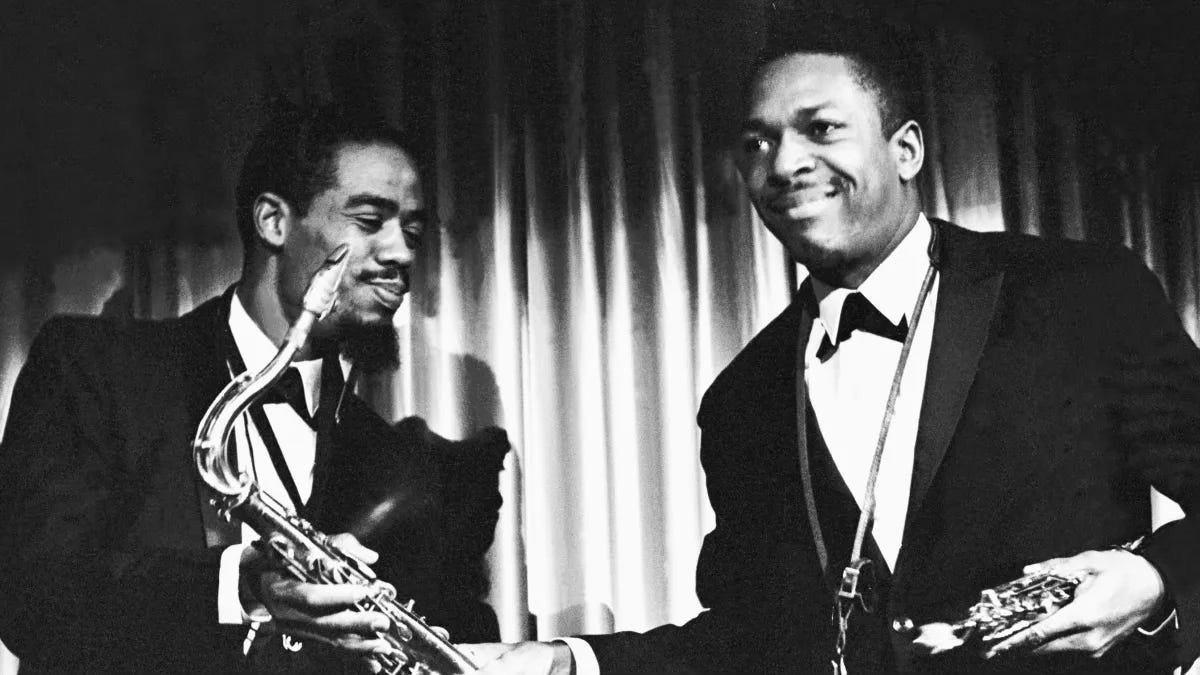
Eric Dolphy and Coltrane
Impressions album
An excellent, driving hard bop album influenced by the music of Indian musician Ravi Shanker. The rock band the Byrds regularly listened to the album which influenced them to write the song ‘Eight Miles High’. Impressions released in 1963 on Impulse records. Rankings: Grammy Hall of Fame, Allmusic 4/5, Downbeat 5/5, Rolling Stone 5/5. Musicians: Coltrane, Tyner, Garrison, Jones, Eric Dolphy bass clarinet.
Tracks
India
Up ‘Gainst the Wall
Impressions
After the Rain
Dear Old Stockholm
John Coltrane and Johnny Hartman album
A Grammy Hall of Fame album considered by many as the best jazz album ever recorded, a wonderful masterpiece, sublime. Coltrane and Hartman excel to new heights in jazz vocal ballads. The songs are seamless, transcend to a oneness rarely seen. “John Coltrane and Johnny Hartman” released in 1963 on Impulse records. Rankings: Allmusic 5/5, Penguin 3/4, Rolling Stone 5/5. Musicians: Coltrane, Tyner, Garrison, Jones, Johnny Hartman vocals.
Tracks:
My One and Only Love (Wood, Melin)
They Say Its Wonderful (Irving Berlin)
Lush Life (Billy Strayhorn)
Dedicated to You (Sammy Cahn)
You Are So Beautiful (Rogers, Hart)
Autumn Serenade (Gallup, DeRose)
Johnny Hartman (1923-1983) a highly acclaimed Grammy nominated jazz and torch ballad singer known for his smooth baritone voice. He worked with Earl Hines, Dizzy Gillespie, Errol Garner, Howard McGhee, John Coltrane, and others.
My One and Only Love by John Coltrane and Johnny Hartman. Composed by Guy Wood and George Mellin.
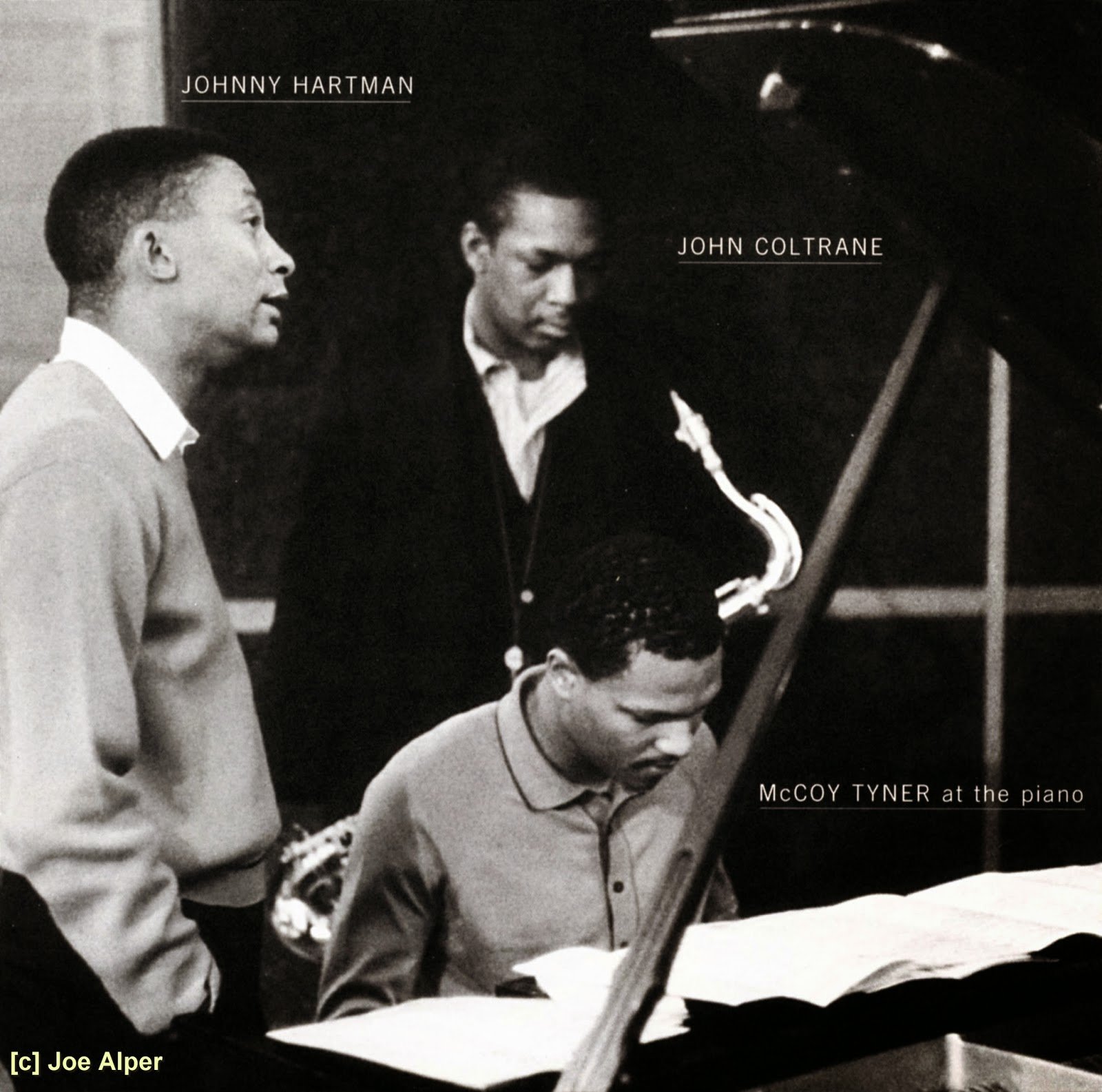
Johnny Hartmman. John Coltrane, McCoy Tyner
Live At Birdland album
Highly acclaimed improvisational hard bop album. Coltrane Quartet in peak form. “Live At Birdland” released in 1964 on Impulse records. Rankings: Allmusic 5/5, Penguin 3.5/4, Rolling Stone 4/5. Musicians: Coltrane, Tyner, Garrison, Jones.
Tracks:
Afro Blue (Mongo Santamaria)
I Want to Talk About You (Billy Eckstine)
The Promise (Coltrane)
Alabama (Coltrane)
Your Lady (Coltrane)
A Love Supreme album
One of the greatest jazz albums ever produced (Downbeat, Rolling Stone, Jazziz, Billboard). A masterpiece, pure delight. Spiritual, improvisational. An acknowledgement to a higher power and a homage to African American churches with a mix of Eastern mysticism. “A Love Supreme” released in 1965 on Impulse records. Rankings: Grammy Hall of Fame, certified Platinum, Allmusic 5/5, Penguin 4/4, Rolling Stone 5/5. Musicians: Coltrane, Tyner, Garrison, Jones.
Tracks
Acknowledgement
Resolution
Pursuance
Psalm
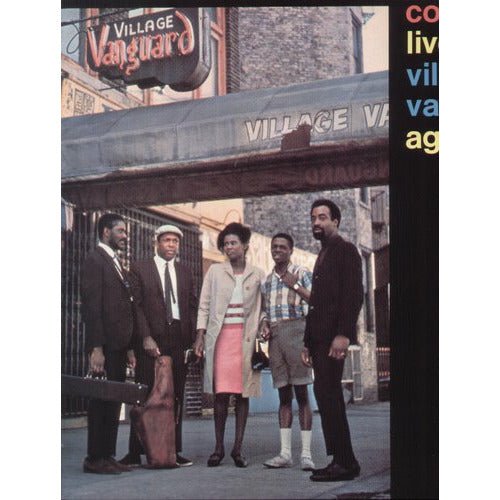
John Coltane, Alice Coltrane, Pharoah Sanders at the Village Vanguard in Greenwich Village, NYC.
References
John Coltrane: His Life and Music, Lewis Porter, University of Michigan, Ann Arbor, 1999.
Coltrane: A Biography, Herndon, NY, Cuthbert Simpkins, 1989.
johncoltrane.com
DownBeat
Jazziz
All Music
Rolling Stone
Biilboard
Jazz Fuel
Jazz Views
Chaospin