Maurits Cornelis Escher, better known as M.C. Escher, was born in 1898 in Leeuwarden, the capitol of Friesland in the Netherlands, into a middle-class family. He was the fifth and youngest son of George Arnold Escher, his father who was a very intelligent man. He was a hydraulic engineer who had worked for years in Japan building harbors and dams.
His mother was Sara Gleichman, George’s second wife. Maurits grew up with in an environment of intellect and discipline. The family lived in a beautiful palace called the Pricessehof. It is almost symbolic that this house later became a ceramics museum. As a child, he was far from being a genius, he was often ill and placed in a special school. He spent a lot of time indoors, where he learned to entertain himself, by observing the world around him very closely.
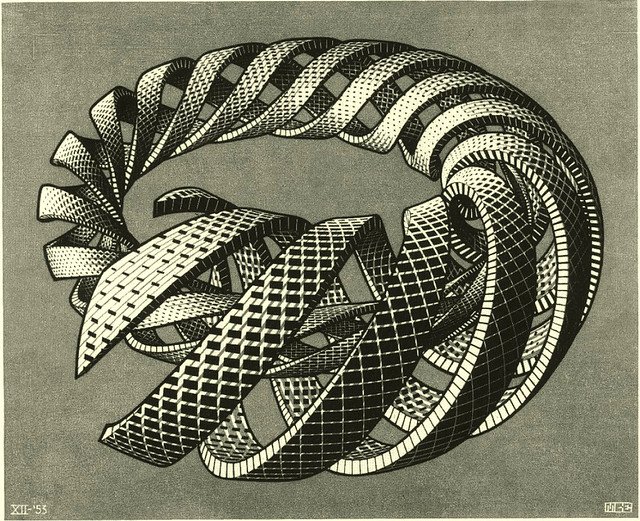
![🔥 [41+] MC Escher Wallpapers HD | WallpaperSafari](https://aoidemagazine.com/wp-content/uploads/2026/08/41-mc-escher-wallpapers-hd-or-wallpapersafari.jpeg)
His father encouraged his sons to be curious but also expected them to work hard. In 1903, the family moved to Arnhem for the work of his father George, who eventually retired in 1908. George wanted to live in a beautiful, green environment. Arnhem, with its parks and forests, was a perfect place for this. They moved unto a large house on the Utrechtsweg. After years of trying to be an artist, although he came from a family of scientist and engineers in the end, Maurits’ grades were too poor. He enrolled in a school of architecture and his dream did motivate him to succeed.
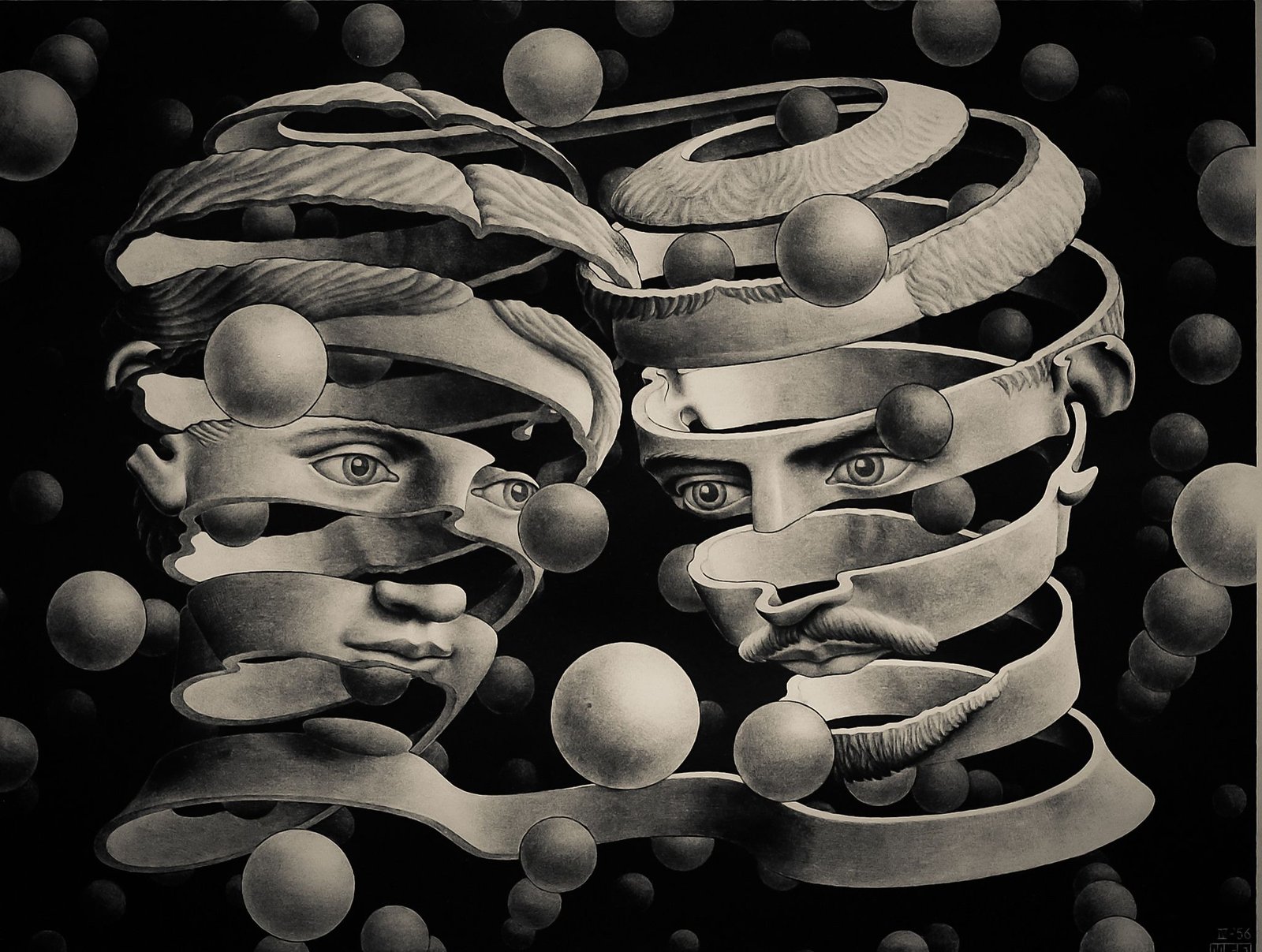
Decorative arts school was his calling, he excelled at this talent. His artistic expression was always there, he just needed to find the style that fit him best. Everything changed when he visited Italy and Spain. He became passionate about old buildings. Escher draws views of places that already have footprints of artistic expression. The perspectives he draws are deliberaty false.
A touch of abstract and realism. He distorts the patterns and emphasizes the details. He was interested in how humanity is connected to the universe, all the heavenly bodies that make up our solar system. The 14th century attached special importance, it became clear that the influence on M.C. Escher would be significant. Geometry and cylindrical perspective. These concepts seem obscure to most. But for Escher these are artists tools, mathematics became his passion and artistic vision.
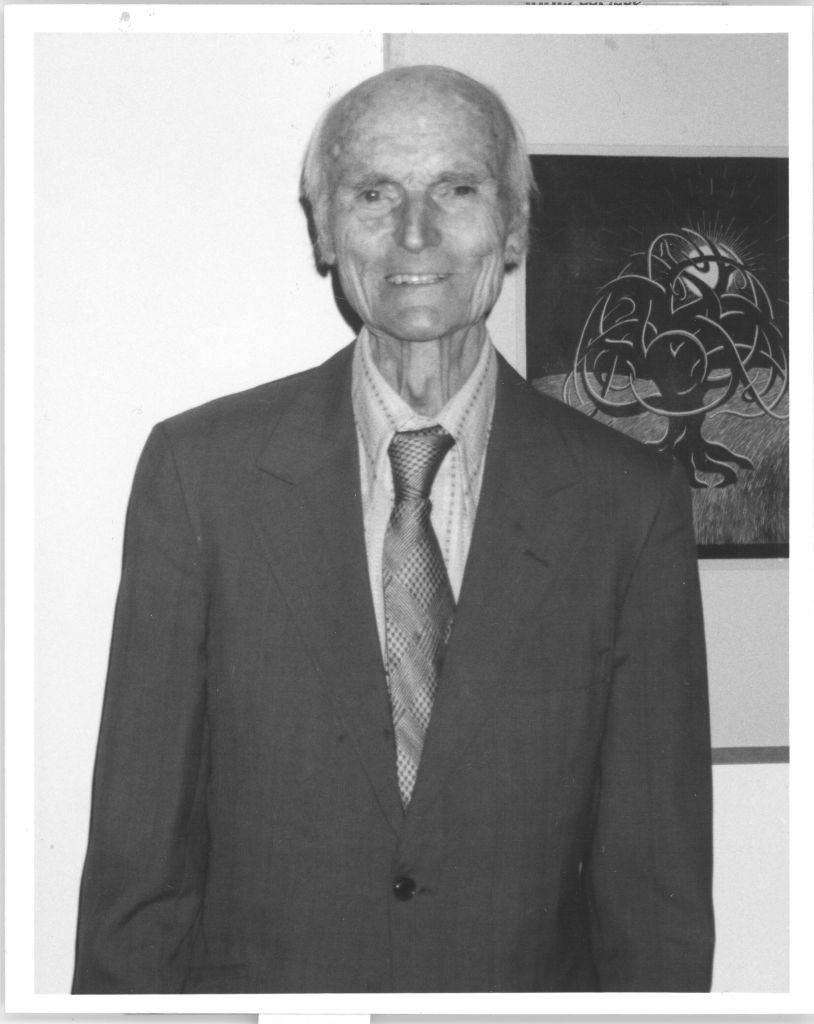
Escher took mathematic theory and turned it into a masterpiece using the concepts of mathematics and geometry. His meeting with his old friends Roger Penrose and Harold Coxeter greatly contributed to the development of his artistic style. His visionary artworks have become masterpieces influenced by mathematical visual projections. A touch of the abstract thought and surrealistic images, that require the mind of the observer to dive into the imagination of their own mind. To find the hidden meaning behind each work of art.
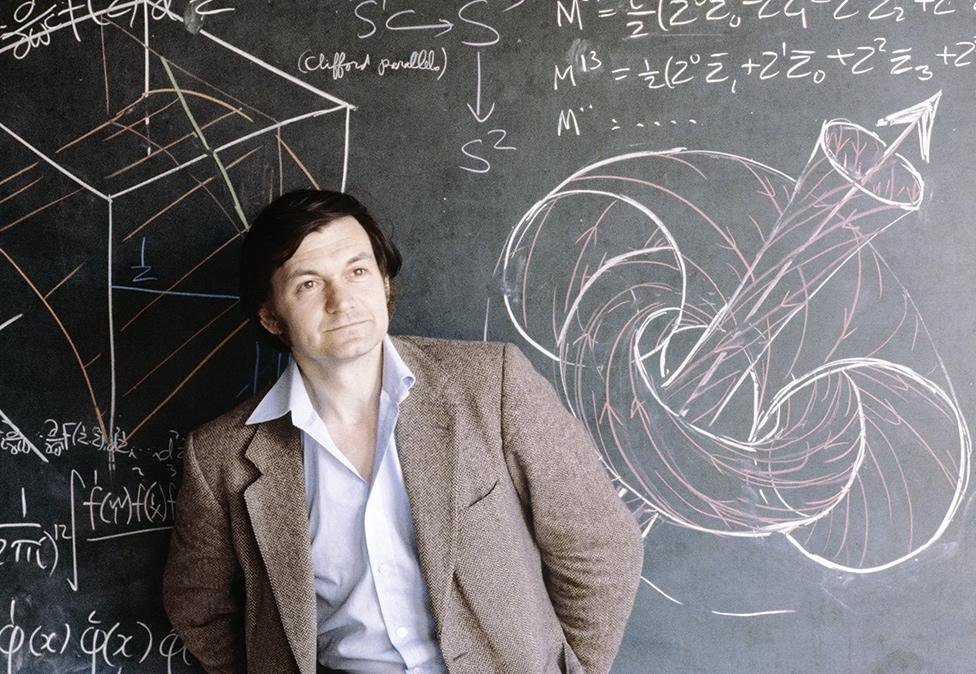
Harold Coxeter and Escher shared a lifelong friendship and collaboration after meeting at an Amsterdam mathematics conference in 1954. Coxeter’s geometric diagrams of hyperbolic tessellations inspired Escher’s iconic “Circle Limit” series, while Coxeter mathematically proved that Escher’s intricate prints captured complex geometry to the millimeter.
During the 1954 conference, Coxeter used Escher’s art to illustrate symmetry. Coxeter sent Escher a hyperbolic tessellation diagram, using the Poincare disk model. Escher, who was trying to figure out how to depict infinity on a flat plane, was mezmorized by it. The “Circle Limit” series sparked by Coxeter’s work, produced his series through masterfully shrinking repeating figures toward an infinitely small boundary.
Coxeter later analyzed his work by using hyperbolic trigonometry and confirmed that the artist had constructed the intersecting arcs and angles with absolute geometric perfection.
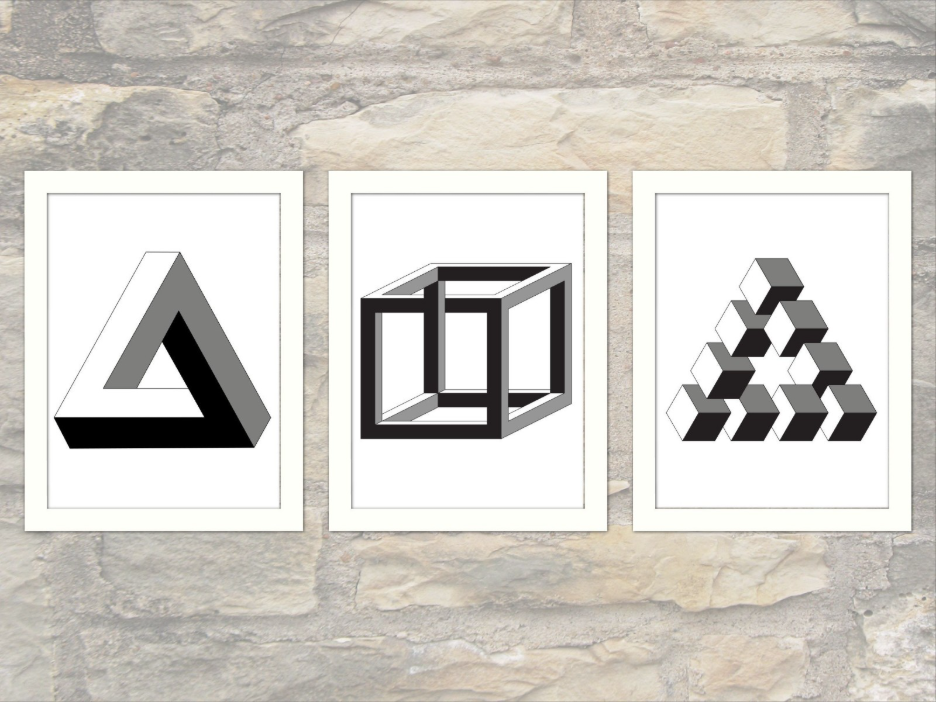
Roger Penrose has conducted outstanding research in pure mathematics and theoretical physics. He is known for his work on singularities, such as black holes, which he proved can arise from a gravitational collapse of massive, dying stars. He also has made important contributions that explore possible connections between physics and consciousness and set these out in bestselling books such as “The Emperor’s New Mind” in 1989.
Roger invented twister theory, a key tool in quantum theory. He proposed the cosmic censorship hypothesis, an idea of how it effects of the unpredictability of singularities are hidden from us. His mathematical discoveries include a non-periodic form of tiling experimentally in quasicrystals.
The impossible triangle or famously known as the Penrose Triangle was first created by Oscar Reutersvard 1915-2002, a Swedish graphic artist known as father of the impossible figure. It is said that he created it in a classroom in 1934 when he was 18 years old.
The illusion was independently discovered later and popularized by Lionel Shaples Penrose 1898-1972. He was a British mathematician, physicist and philosopher of science. His son Sir Roger Penrose published “The Illusion” in the British Journal of Psychology, with his father in 1958.The Penrose Triangle is an impossible figure, and it depicts an object which could not possibly exist, for if it would exist, it goes against the laws of geometry.
Follow the shape of the triangle starting at the top point, note how the left side seems to extend towards you, yet they seem to lie on the same plane when they reach and are connected by the bottom verticals. When a person observes the drawing, they notice that each of the two interpretations is valid. But once observed, they will tend to focus on one reading. Making the other to disappear, creating a multiple perception. Finally, the Penrose triangle, named after M.C. Escher’s friend Roger Penrose.
It is an object that can only exist in two dimensions. On paper, once entered the third dimension one notes that only one optical effect is visible. Mathematicians have studied the properties of the impossible figures to try to develop formulas and algorithms for modeling the impossible objects.
Among these, others are the Mobius Ribbon, which was first described in 1858. It was an endless ribbon, having neither an interior nor an exterior, only one-sided. There is also the Necker’s Cube, mentioned in 1832. It is a drawing of the edges of a cube, when two lines cross. The drawing does not show which is in the front and which is behind. That makes the drawing ambiguous and it can be interpreted in two different ways.
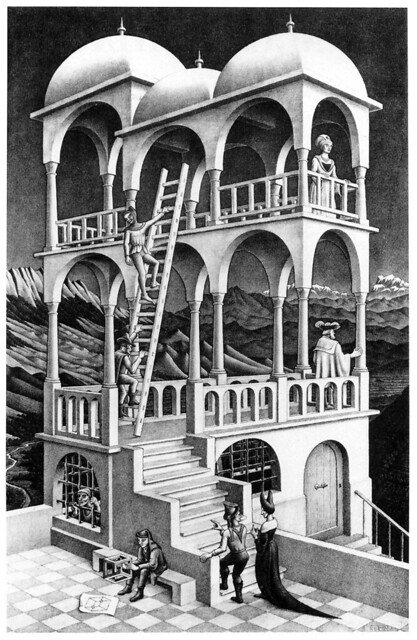
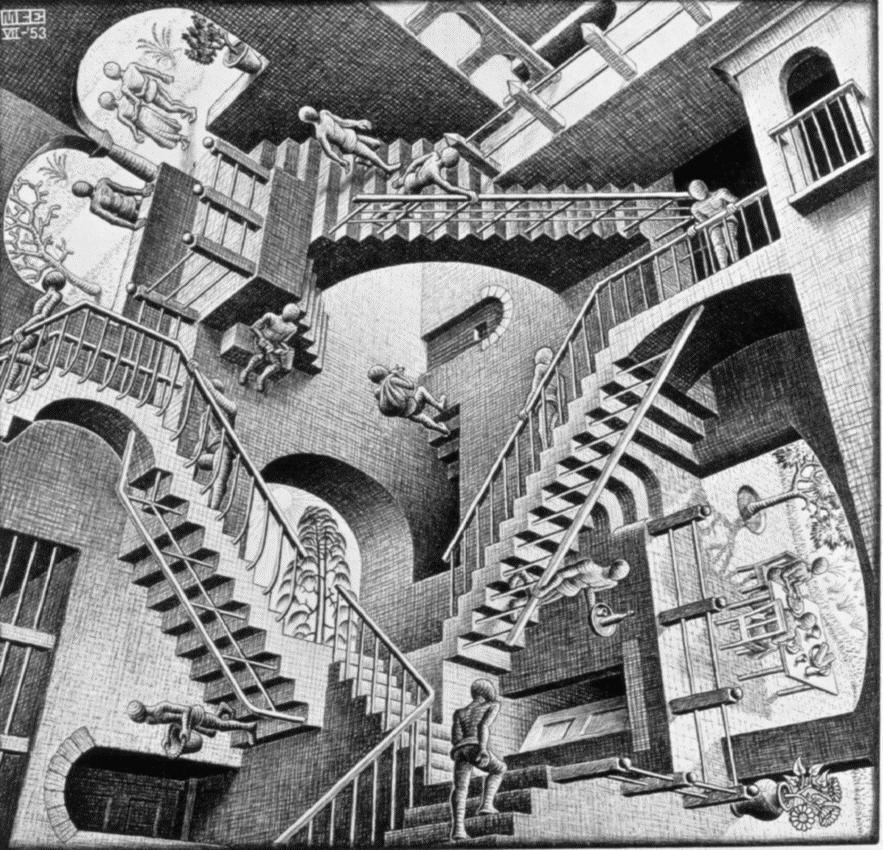
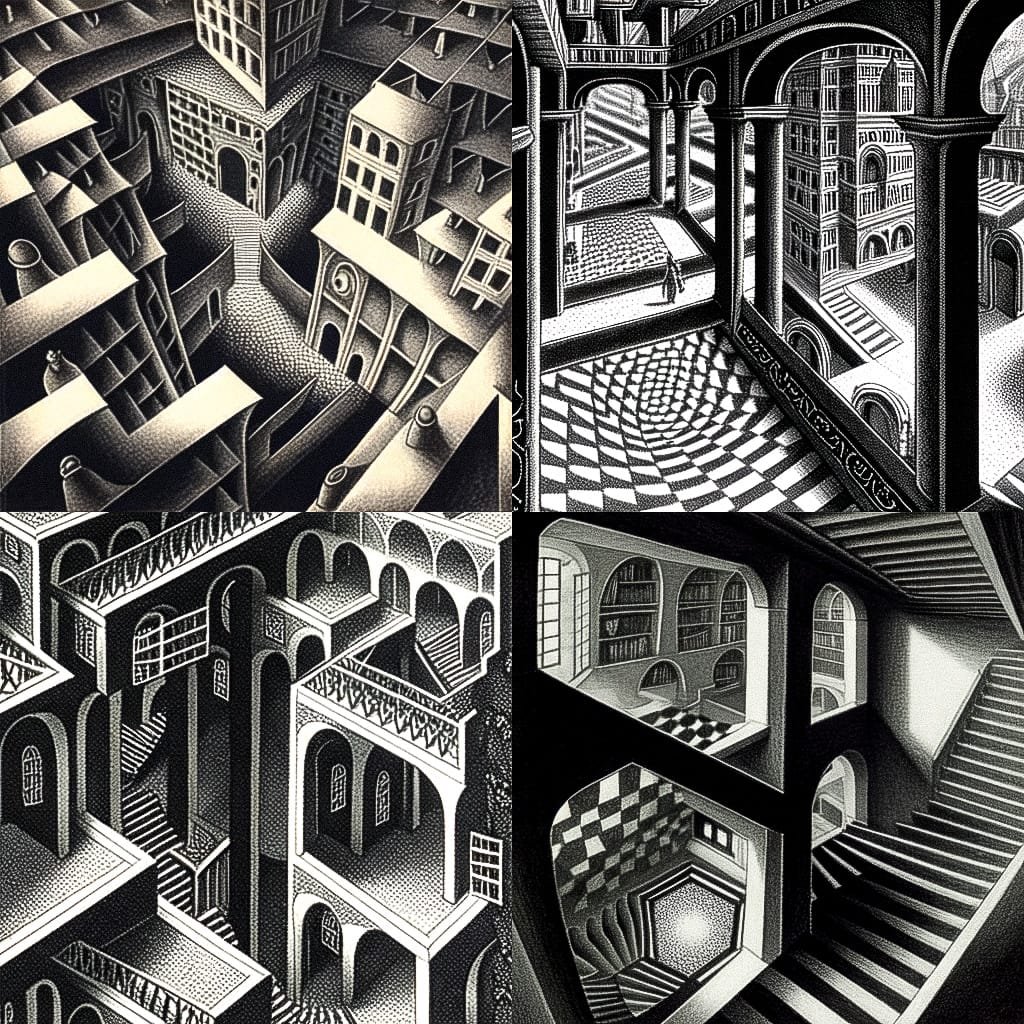
Esher is known today as one of the greatest artists of surrealism, along with other great artists like Salvador Dali and many others. His interest in impossible objects with multiple of viewing points or by optical stratagems, manage to create forms that cannot exist in the real world. M.C. Escher produced 448 prints and more than 2,000 drawings and sketches. Some of these have contributed to his fame. In particular, “The House of Stairs” a house that is all turned upside down.
Thanks to multiple points of view, the architecture of this house is totally impossible. Not only is gravity unrealistic but so is its reality. Inside though you see the Primrose Triangle. Inside the chaos, you see mathematics and geometry, order amidst the abstract reality. In parallel with mathematical theories he puts images into the world.
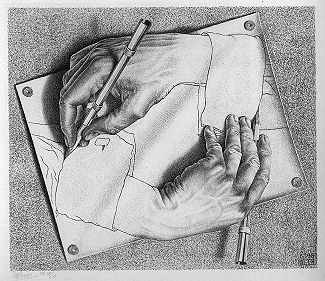
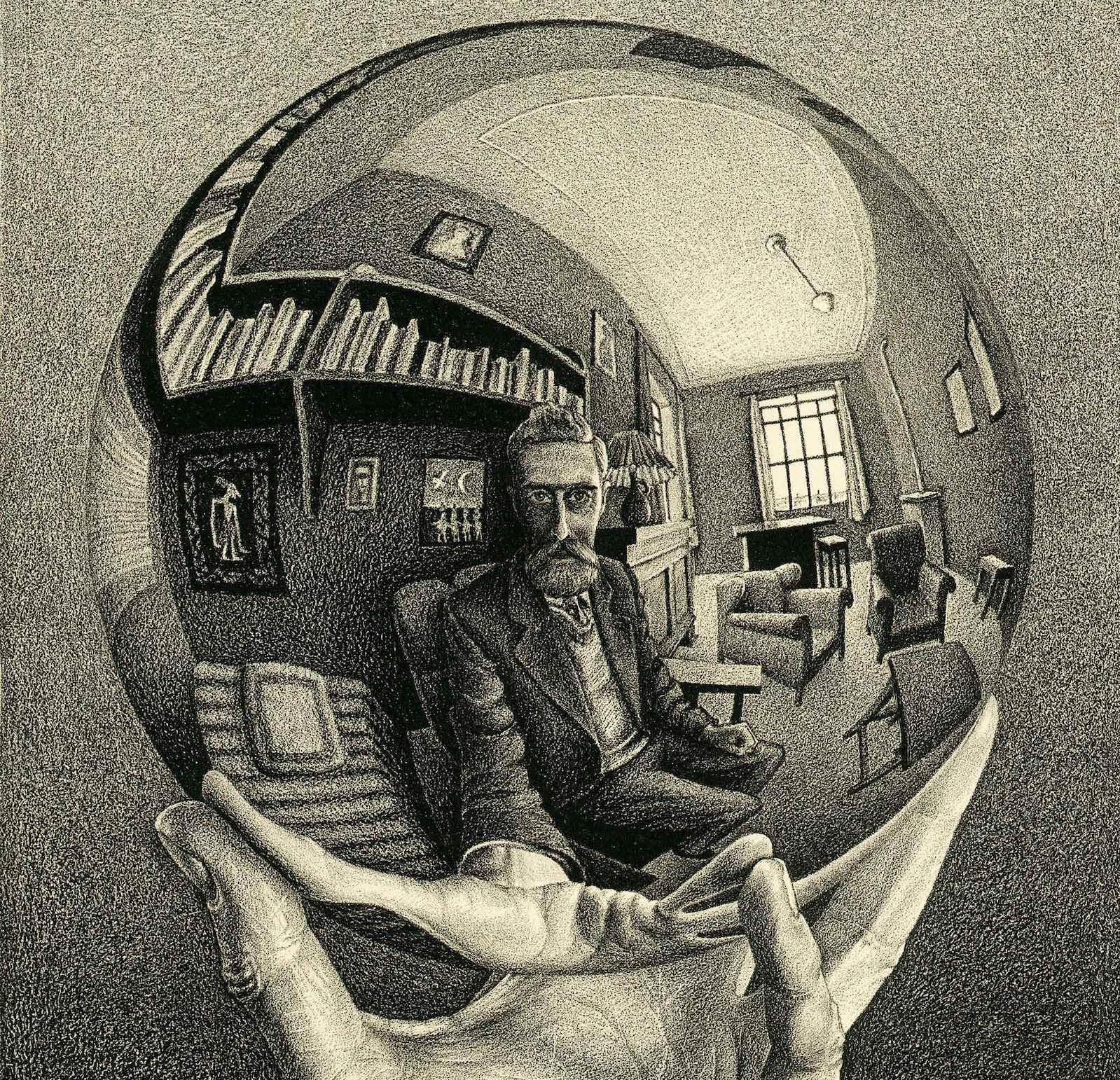
Escher’s drawings are very much inspired by the art of trompe-l’oeil. The illusion of the drawing coming off the page. Tricks the eyes and reveals the optical effects. Thanks to the perspective effects played by light and shadow. The hands come out of the picture to finish the picture. Brillant optical effects.
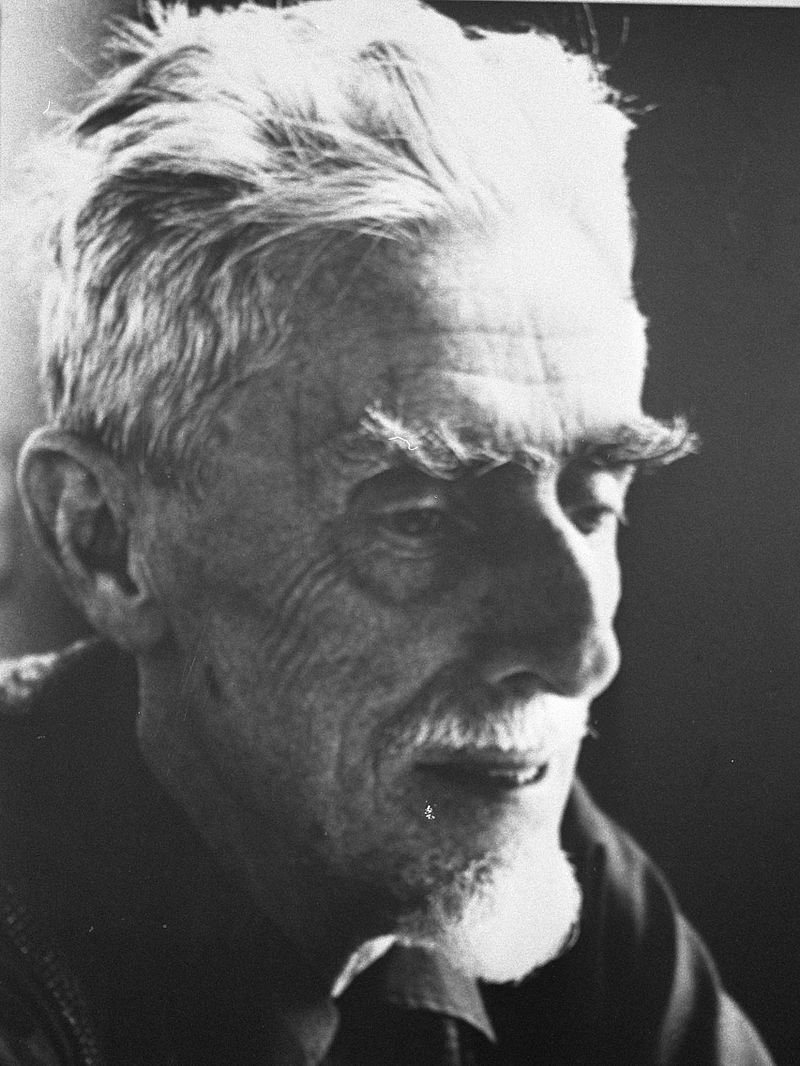
Since the Renaissance, the rules of perspective have remained relativity unchanged. Indeed, to represent volume or depth. The first thing to do is to determine one or more vanquishing points. It is an imaginary point, which represents the direction of the gaze.
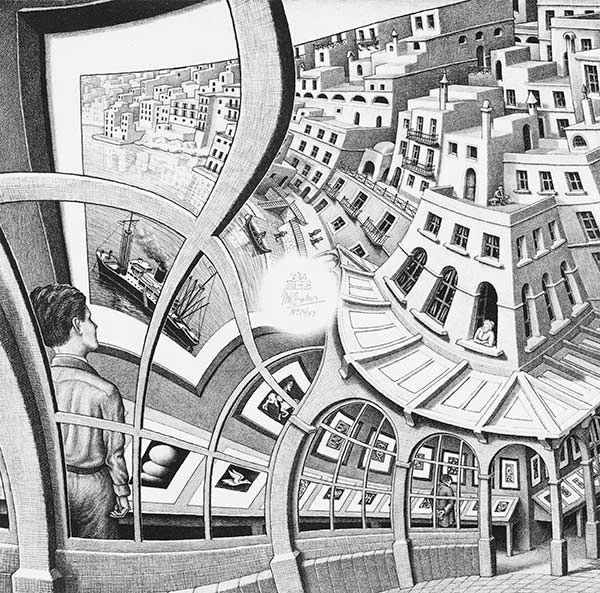
However, according to M.C. Esher, and a few other artists before him, this technique of perspective is incorrect. Indeed, it does not take into the account the retinal perspective. That is, the fact that the human eye perceives volumes not in straight lines, but in curves.
In a convex way of seeing the world. He calls it a cylindrical perspective. In one of his unpublished works, left undone. His unfinished work has remained unfamous. He attempted to finish it before he died, but the center remained empty. Until a few years ago, a team of mathematics’ students, from the University of Leiden, solved it. By using a mathematical notion called “Riemann surface” they completed the void left by Esher.
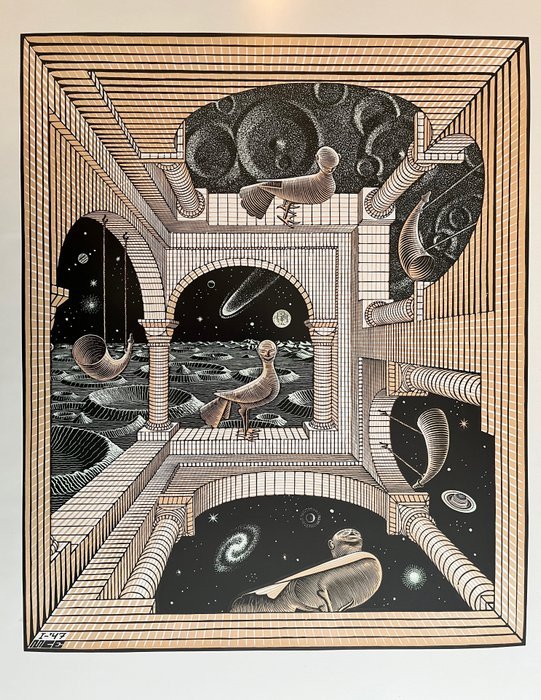
From the torsion grid left by the artist and by proceeding with expansion and visual projection. In the end, they succeeded in solving the enigma. Today, M.C. Esher is an artist who is internationally recognized for his visionary works. He has strongly inspired sculptors, novelists, and filmmakers. To compose, impossible and phantasmagorical universes, where reality and perception are twisted and abstract.
Some video games and art programs have tried to copy his style. The legacy of this amazing artist and his genius will always be known as one of the masters of perception and surrealism.