I grew up listening to Franz Schubert’s music played by my mother who was a classical pianist. His music is simply wonderful, joyous, tender, yet often bold, dark, and complex. He challenges your mind and senses, captures your heart, and touches where you are most vulnerable. Later in life I delved deeper into Schubert and discovered many of his great works. The post-Beethoven composers Schubert, Chopin, and Mendelssohn have always remained among my favorite classical composers.
Schubert’s Life
It is very unfortunate that Franz Schubert died so young at 31 when he was just gaining popularity. He was relatively unknown outside of the music community in Vienna. During his life he composed a prolific amount of music, over 1,500 works, which includes nine symphonies, 17 operas, 24 piano sonatas, over 600 lieder songs, sacred music, chamber music such as quartets, quintets, and trios, and a large volume of solo piano music.
Born in Vienna, Austria in 1797 to a musical family where his father taught him the violin and his brother taught him piano. Young Schubert was a musical prodigy and in 1808 at age 11 he entered the Stadtkonvikt School. There he was influenced by the music of Haydn, Mozart, and Beethoven. He studied music with Antonio Salieri for many years. In 1821 Schubert was admitted to the Gesellschaft der Musikfreunde as a performing member.
His reputation grew in Vienna as a gifted musician and composer but never reached the acclaim that he deserved. Shortly before he died he gave a concert of his works to critical acclaim in March 1828, the only time he did so in his career.
After his death he was eventually celebrated and promoted by numerous composers, such as Felix Mendelssohn, Robert and Clara Schumann, Franz Liszt, Frederic Chopin, Johannes Brahms, Hector Berlioz, Antonin Dvorak, Anton Bruckner, Richard Strauss, and others.
By the 20th Century Schubert was recognized as one of the greatest classical composers in history, attaining the exulted ranks as such greats as Bach, Mozart, Beethoven, and Chopin, among others. Schubert is seen as a natural musical genius like Mozart.
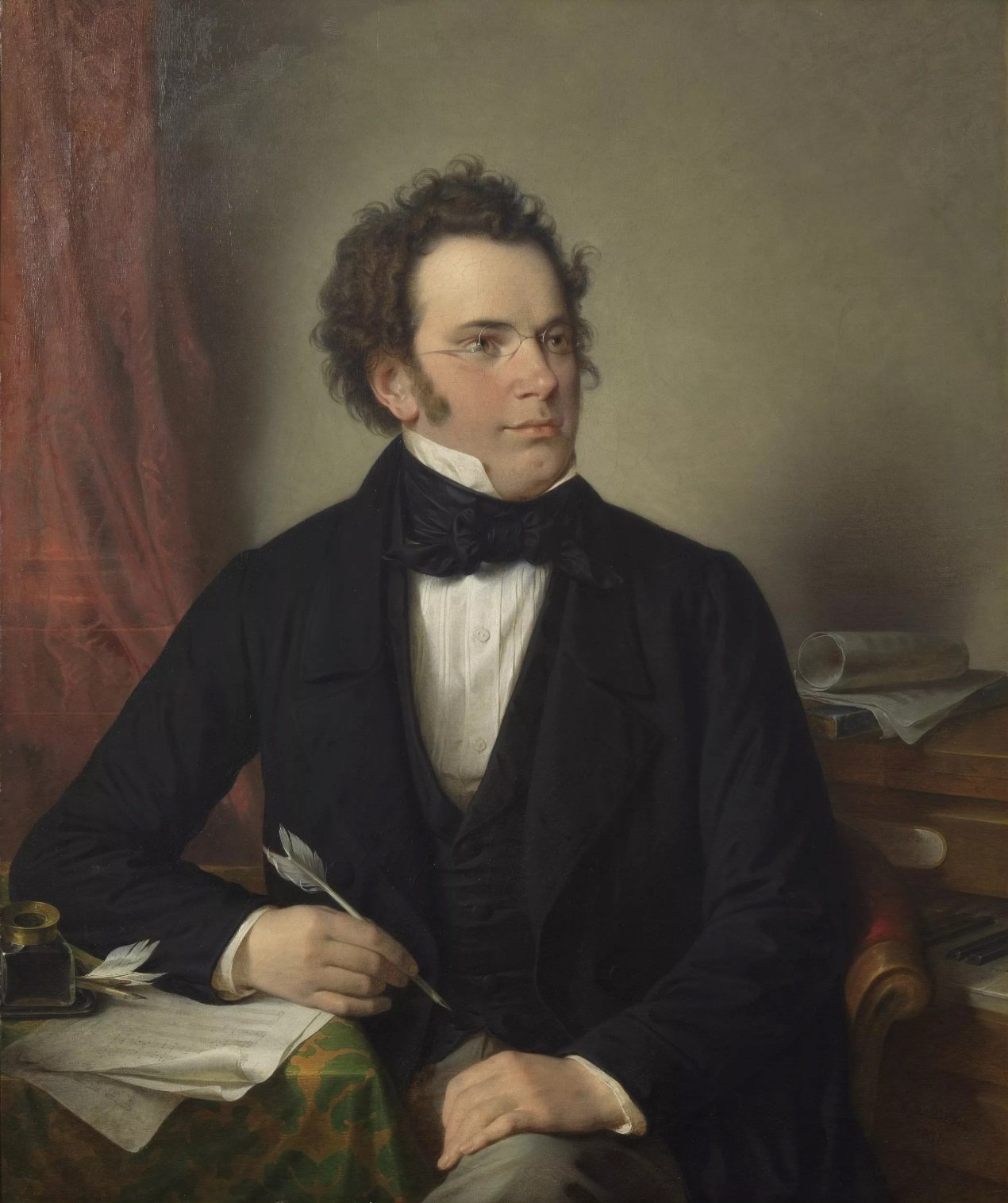
Critics’ Praise of Schubert
Ludwig Beethioven said, “Truly the spark of divine genius resides in Schubert.”
Ernst Krenek, “There is ample evidence that Schubert was much more than an easy-going tune-smith who did not know, and did not care, about the craft of composition.” With “a great wealth of technical finesse” and “far from satisfied with pouring his charming ideas into conventional moulds; on the contrary he was a thinking artist with a keen appetite for experimentation.”
Grillparzer, “Here music has buried a treasure, but even fairer hopes.”
Radu Lupu, “Schubert is the composer for whom I am really most sorry that he died so young… Just before he died, when he wrote his beautiful two-cello String Quintet in C, he said very modestly that he was trying to learn a little more about counterpoint, and he was perfectly right. We’ll never know in what direction he was going or would have gone.”
Robert Schumann who promoted his work, “It is pointless to guess at what more Schubert might have achieved. He did enough; and let them be honoured who have striven and accomplished as he did”.
András Schiff, “Schubert lived a very short life, but it was a very concentrated life. In 31 years, he lived more than other people would live in 100 years, and it is needless to speculate what could he have written had he lived another 50 years. It’s irrelevant, just like with Mozart: these are the two natural geniuses of music.”
New York Times music critic Anthony Tommasini, who ranked Schubert as the fourth greatest composer, wrote of him: “You have to love the guy, who died at 31, ill, impoverished, and neglected except by a circle of friends who were in awe of his genius. For his hundreds of songs alone – including the haunting cycle Winterreise, which will never release its tenacious hold on singers and audiences – Schubert is central to our concert life… Schubert’s first few symphonies may be works in progress. But the Unfinished 8th Symphony and especially the Great C major 9th Symphony are astonishing”.
Franz Liszt, who was a significant force in spreading Schubert’s work after his death, said Schubert was “the most poetic musician who ever lived.”
“The Unfinished” Symphony No. 8 in B-minor, D. 759, conducted by Wilhelm Furtwangler, Berlin, 1953
One of the greatest and most beloved symphonies ever composed. Awe inspiring, grand, majestic, profound, and compelling. Completed in only two movements in 1822, this symphony is famous for its emotional range and haunting beauty. Its opening theme, with sweeping strings and dark, somber mood, is considered a milestone in Romantic orchestral literature. The two finished movements convey mystery, melancholy, and lyricism, leaving listeners with a sense of unresolved longing. It is said that Schubert did not compose a third movement because he considered the two movements great on their own. The symphony was discovered 37 years after Schubert’s death.
String Quartet No. 12 “Quartettsatz”, in C minor, D 703 by the Amadeus Quartet
The string quartet was discovered by Johannes Brahms in 1870. Considered the first of Schubert’s ‘mature’ work. The piece is fun, delightful, enjoyable, and dramatic and thrilling.
Moment Musical No. 3, F minor, D 780 played by Vladimir Horowitz
A fun, playful, and delightful piano work, part of four short piano pieces. One of Schubert’s most famous and celebrated solo piano pieces.
Horowitz plays Schubert Moment Musical No 3 in minor:
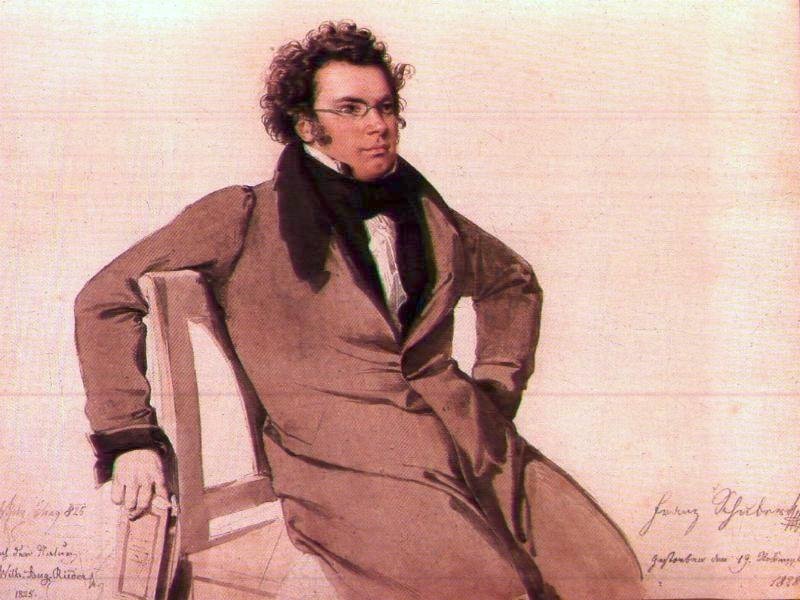
Impromptus
Piano solos celebrated for their lyrical elegance, flowing triplets, and expressive intimacy. Schubert’s Impromptus are poetic miniatures, balancing virtuosity with introspection. Composed in 1827.
Impromptu No. 4, in A-flat, Op.90, D899 played by Evgeny Kissin
Impromptu No. 3, in G flat major, Op. 90, D 899 played by Khatia Buniatshvili
Trout Quintet in A major, D 667 played by the Schubert Ensemble
One of Schubert’s most beloved and influential chamber works, the “Trout Quintet” is scored for piano, violin, viola, cello, and double bass. Schubert composed the work in 1819 when he was 22 years old. Schubert said that he wanted to create an image of natural scenic beauty, which he succeeded in doing quite well. The work is charming, buoyant, delightful, and playful, portraying a trout swimming among beautiful scenery. It is one of his best and most popular works often played in concert and in many film and TV productions.
Symphony No. 5, in B major, D 485, conducted by Herbert von Karajan with the Berlin Philharmonic
Schubert’s 5th was inspired by Mozart and Haydyn older musical style. It is a popular symphony that is delightful, dramatic, stirring, melodic, and with harmonic surprises.
Schubert: Symphony No.5 in B major, D 485 (Herbert von Karajan):
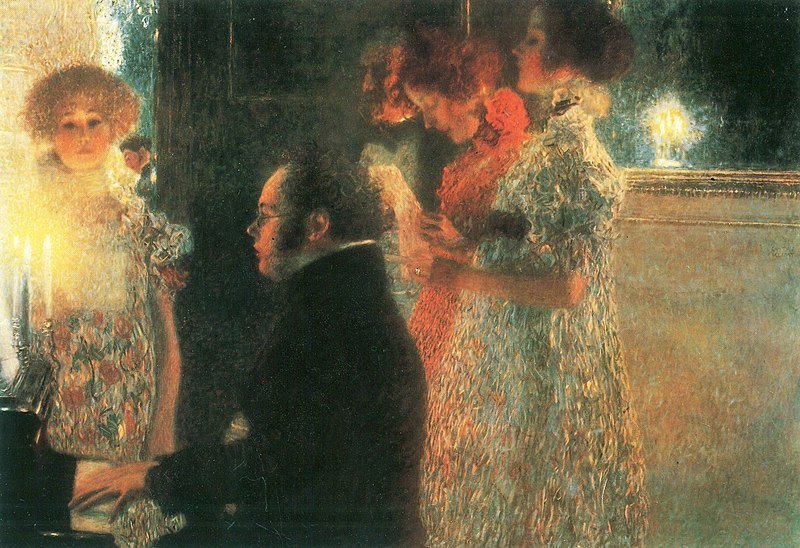
Schubert At the Piano, Gustave Klimt, 1899.
Gretchen am Spinnrade, lieder song, Op. 2, D 118, sung by Elly Ameling
A popular lieder song of a poem from Johann von Goethe’s Faust where Gretchen sings of her love of Faust which in turn wards off the Devil trying to capture her soul. A very heartfelt and bittersweet ballad, very moving and dramatic. Composed by Schubert in 1814.
Ava Maria, lieder song, Op. 2, No. 6, D 839, sung by Pavarotti
A very popular lieder song which has become a sacred hymn to the Virgin Mary. Very inspirational, tender, graceful, and beautiful. Composed by Schubert in 1825.
Erkonig, lieder song, Op.1, D 328, sung by Anne Sofie von Otter
A popular and highly acclaimed, heartfelt lieder song from a Goethe poem about an evil spirit trying to seduce then seize the soul of a young boy. A dramatic and thrilling piece of music portraying the father racing the carriage to escape the evil spirit as the dying child weakens. The singer sings the voices of four characters, the narrator, father, son, and evil spirit. Composed by Schubert in 1815.
Fantasia, F minor, Op. 103, D. 940
Piano with four hands. One of the most popular piano pieces, among the his greatest and most original. Fugue like, bright, lively theme that alternates to darkness and turbulence. Composed in 1828.
Stanchen (Serenade) D. 889, played by Camille Thomas (cello) and Beatice Berrut (piano)
A quintessential Romantic lieder song for either vocal or adapted for piano, violin, or cello. It is a tender, graceful, and poetic ballad composed by Schubert in 1826. One of Schubert’s best-loved short vocal works.
Piano Trio No. 2, in E-flat major, op 100, D929
The Trio is one of Schubert’s best loved works composed in 1827. A regular piece in concerts and has been used in many movies, TV shows, and documentaries. A delightful, playful work full of passion and reflection, intense hypnotic chords, dance movements interrupted with outbursts of virtuousity. The Andante movement is especially beautiful, very haunting.
“Death and the Maiden” String Quartet, No. 14, in D minor, Op. D. 810, played by the Alban Berg Quartet
Schubert’s most famous quartets and his most innovative chamber music. An urgent, dark, dramatic, intense quartet named after Schubert’s earlier song “Death and the Maiden.” The whole work explores themes of fate, mortality, and struggle, marked by stormy energy and passionate beauty. Composed in 1824.
Symphony No. 9, C major, “The Great”, Op. D 944
Composed in 1826 but not published until 1849 after it was discovered by Robert Schumann. A tour de force, considered Schubert’s most innovative work and one of his best. Majestic, regal, grand, dazzling. Dynamic orchestration, expansive melodies, driving rhythm, and jubilant finale.
Other Important Schubert Works
- String Quintet, in C major, D 956, Op. 163
- String Quartet No. 13 ”Rosamunde”, in A minor, D 804, Op. 29
- Octet, F major, D 803
- Cello Sonata “Arpeggione”, D 821
- Trio Nottornu, E flat, Op. 148, D 897
- String Trio, B major, D 471
- Piano Sonata No. 19, D 958
- Piano Sonata No. 20, d 959
- Piano Sonata No. 21, D 960
- Imfruhling, lieder song, D 882
- Die Junge Nonne, lieder song, D 828
- Suleika, lieder song, D 720
- Ellens Gesang, lieder, D 837
- Seligkeit, lieder, D 433
- Die Forelle, lieder, D 550
- Kennst du des Land, lieder, D 321
- Ich wollt ich war ein fisch, lieder, D 558
- An Sylvia, lieder D 891
- Seligheit, lieder, D 433
References
Album liner notes
Classic E
Discover Music
Classic FM
Classical Beat
Classical Music
Cmuse
Gramaphone