Old Celtic Christmas traditions of the English, Irish, Welch, and Scottish are also popular in other English speaking countries such as the U.S., Canada, Australia, New Zealand, and elsewhere. They include Medieval, Old English, Irish, Scottish Gaelic, Welsh, and Latin folk songs, hymns, and carols.
“Wexford Carol”, song
A 15th Century Irish Christmas carol. Performed by highly awarded bluegrass singer Alison Kraus with acclaimed classical cellist Yo Yo Ma.
“The Holly and the Ivy”, song
A Medieval traditional British Christmas carol. Performed by the Mediaeval Babes that sing traditional English, Irish, Gaelic, and Latin folk songs and carols using period instruments.
The Celtic Peoples
Celtic peoples emerged in the Bronze and Iron Ages and migrated to Gaul (France), Brittany (France), Britain, Wales, Cornwall, Scotland, Ireland, Spain, and Portugal. They were engaged in Atlantic maritime trade from Spain and Portugal up to Norway and Denmark. Celts were governed by Druid priests which practiced a pagan Nature spirits religion. The Roman Empire controlled Britania from 47 BC to 410 AD. The King Arthur legends arose in the post-Roman British Isles where Britons fought the Angles and Saxons, and later Norway and Denmark. Later the Normans, descendants of Celts, in 1066 took over Anglo-Saxon England.
Britons are the original British peoples based in the pre-Anglo/Saxon land of Old England and the Arthur legends. The UK current population is 69.3 million, with English population in the U.S. 46.6 mil, Australia 8.3 mil, Canada 5.3 mil, and New Zealand 3.3 mil. Britons were Celtic speaking people that diverged into Britons, Welsh, Cornish, and Bretons in France.
“Gloucestershire Wassail”, song
A traditional British Christmas caroling song of the 17th Century. Performed by Quadriga Concert that performs traditional British and Irish folk music with period instruments.
“The Yule Fiddler”, song
Performed by Patty Gurdy a German folk singer of Medieval songs.
Wales is the far western Britain country of the Welsh people who have their own language. Welsh mythology is the origins of the Arthur and Merlin legends. Wales current population is 2 million, with Welsh population in U.S. 2 mil, England 610K, Canada 475K, and Australia 126K. Wales emerged in the 5th Century after Roman rule and was conquered by British King Edward I in 1283.
Scotland is in the far north Lowlands and Highlands with the Scottish Gaelic speaking people descended from the Picts. Scotland was never conquered by the Romans, Angles, Saxons, or Normans. Scotland current population is 4.2 million, with Scot populations in U.S. 9.2 mil, Canada 4.7 mil, England 795K, Australia 2.1 mil, and New Zealand 2 mil. Scotland was a sovereign state in the 9th Century. The British invaded Scotland in 1296 and Robert Bruce won independence in 1306 and became the Scottish King. The House of Stuart united Scotland and England under one King in the 17th Century. Scotland became part of Great Britain in 1707.
Ireland is the western isle with 5.7 million Irish people, both south and north Ireland, who have their own Irish language. Ireland population is 5.1 million and North Ireland is 627K, with Irish population in the U.S. 36 mil, England 1.4 mil, Australia 7 mil, Canada 4.6 mil, and New Zealand 600K. Ireland was Christianized in the 5th Century. The British Tudor kings conquered Ireland in the 16th Century and Oliver Cromwell reconquered Ireland in the 1640s. Ireland was ruled by the British until Irish Independence in 1921.
Cornwall is in southeast England and is made up of Cornish people with their own language. Cornwall also added stories to the Arthurian mythology. The Cornwall population is 532,300.
“Bells of Dublin” song
A traditional Irish Christmas song performed by The Chieftains.
“In the Bleak Midwinter” carol
A British carol based on the 1872 poem by Christina Rosetti, set to Gustav Holst music in 1906. Performed by Orla Fallon, an Irish singer who was formerly with the group Celtic Woman.
Breton people are in northwest France with their own language who emigrated from southwest Britain (Cornwall, Devon) to escape Angle-Saxon invasions, mostly between 450 to 600 AD. Population in France is 7 million, including Brittany with 3.3 million.
Canada concentration of Celtic – New Foundland, Cape Breton, and Prince Edward Island.
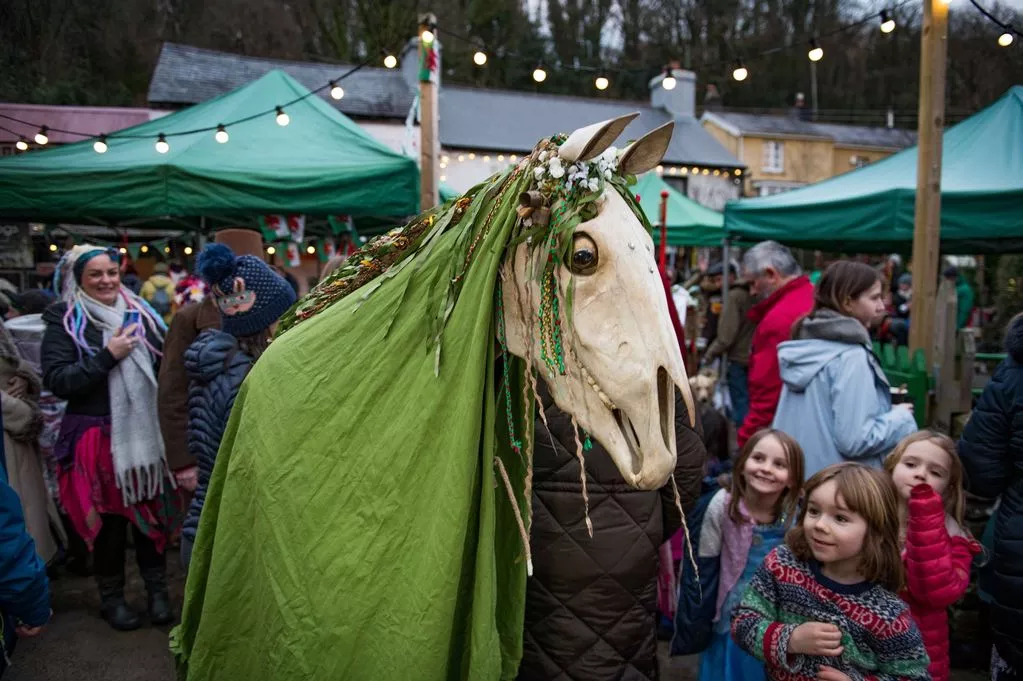
Welsh Christmas tradition with Mari Lwyd hobby horse costume bringing good luck.
United States -British colonial America was originally settled by English, Scottish, and protestant Scottish-Irish from Ulster in all the British colonies. Settlers came to prosper freely and to escape religious or economic oppression. Scottish emigration to America was accelerated by: 1) the failed 1745 Jacobite rising to re-establish the House of Stuart on the British throne; 2) the Highland Clearance evicting tenant farmers from the land in 1750 to 1860; and 3) the Highland Potato Famine of 1846 to 1851.
“Christmas Angels” song
Performed by award winning Irish band Clannad.
Irish emigration to the United States was accelerated by the 1845 to 1855 Irish Potato Famine which killed 1 million and 3 million emigrated out of Ireland to England, Wales, Canada, U.S., and Australia. By 1850 Irish made up a quarter of the population of Boston, New York, Philadelphia, and Baltimore.
Appalachia has a high concentration of Scots and Scottish-Irish from Ulster. As land in the colonies was already owned, immigrants had to keep moving further west to Appalachia. The Appalachian people have kept Celtic culture and music alive up to the present. Colonies with the highest concentration of Scots and Scottish-Irish during the American Revolution were Appalachian colonies North Carolina, Virginia, South Carolina, and Pennsylvania.
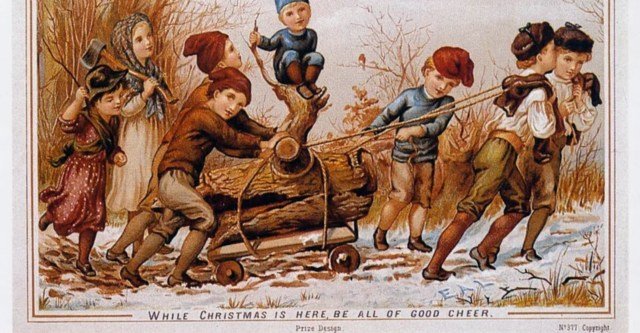
Bringing in the yule log
Celtic Christmas Traditions
Winter Solstice – the shortest day of the year in the Northern Hemisphere when days start to get longer and heat and light from the sun increases. A sacred event from ancient times representing the rebirth of Nature and agriculture.
Wassailing – traditional Christmas caroling house to house offering a drink from the Wassail Bowl.
Wassail Bowl – a traditional alcoholic drink going back to Celtic and Norse times. It is a large pot filled with hot mulled cider mixed with wine, ale, fruit, and spices. The feudal lord would offer the Wassail Bowl to his subjects at Christmas time.
Twelve Days of Christmas – from December 25 to January 6. A time for family, feasting, drinking, storytelling, and singing.
Holly is an evergreen flowering plant with red berries. It was considered a sacred plant by the Druids and in Medieval times. Holly is considered to ward off evil spirits. Holly wreaths are traditional decorations.
Misteltoe – is a parasitical plant that attaches itself to trees. Considered a sacred plant in Druid, Roman, and Medieval times that protects against evil spirits and heals the home. Misteltoe is a symbol of male fertility, which gives male the right to ask for a kiss during Christmas time.
“Breton Carol” song
A traditional Irish Christmas carol performed by The Chieftains, a six times Grammy winning Irish folk band.
Evergreens – evergreen pine trees were considered sacred plants from Druid, Celtic, Norse, and Roman times. The trees represent deities of the sun, mood, and stars. Evergreen wreaths and decorations are adorned in homes and public places to represent life and resilience.
Yule log – a Celtic, Norse, Roman, and Medieval tradition. A large oak log is pulled in doors, cut up, and burned in the hearth during Christmas time. It represents the return of warmth and light after the winter solstice.
Light in the Window – a tradition of leaving a candle in the window on Christmas Eve to help guide Mary and Joseph on their journey to Bethlehem.
Mince Pies – a spicy raison pie with fruits and the spices of cinnamon, cloves, and nutmeg, the same spices for pumpkin pie. The three spices represent the three Magi that gave gifts to baby Jesus.
Christmas Markets – are traditional town events that go back to Roman and Medieval times. Christmas markets take place across Europe. They include selling gifts, decorations, textiles, tableware, metalware, furnishings, jewelry, clothing, food, cheeses, wines, spirits, mulled cider, candy, baked goods, and more. Events include music, games, rides, and theater.
Christmas Gifts – a tradition going back to ancient times of clans and chieftains exchanging gifts to renew ties and friendships. In Christian times it represent the gifts of the Magi.
Chasing the Wren – a traditional game on St. Steven’s Day, Boxing Day, on December 26 the day after Christmas. Young boys in straw hoods hunt for wren birds.
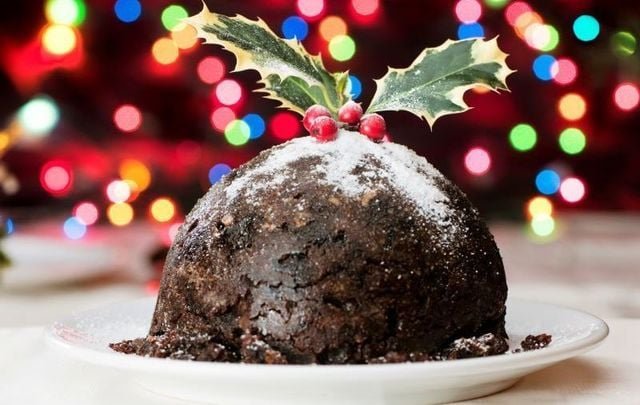
Traditional plum pudding with holly
Traditional Christmas Food
Christmas dinners are traditionally roast turkey with all the trimmings, but ham, beef Wellington, or goose are alternative entrees. Seafood and shellfish are often side dishes along with a variety of breads, vegetables, salads, and abundant desserts.
English Christmas Food – mulled wine, gingerbread, roasted chestnuts, fruit cake, Christmas pudding, mince pies, trifle, tarts, cakes, candy canes, cranberry sauce, Brussel sprouts, soda biscuits, Eccles tart, kippers, potted shrimp, spotted dick, toffee pudding, sponge cake, treacle tart, and more.
“Good King Wencelas” carol
A 13th Century carol about the 10th Century king that gave alms to the poor. Performed by The Rovers, an award winning Irish folk band that sings Celtic and Irish music.
“Coventry Carol”
An English Christmas carol from 1372, performed by Loreena McKennitt a Canadian singer of Celtic, Irish, and folk songs.
Scottish Christmas Food – whiskey drinks, shortbread, yule bread, Dundee cake, trifle, tarts, clootie dumpling, Christmas pudding, smoked salmon, Scotch broth, Brussel sprouts, turnip, neeps, tattie potatoes, cullen skink soup, cranachau, Arbroth smoked fish.
Welsh Christmas Food – mead, goose blood tart, Christmas pudding, tarts, cakes, loaf cake, current bread, pulled toffee, sweet white sauce, crempogau, tatwr pum munuo, Welsh rarebit, cawl, cockles, mussels, bard brith, teison lap, Aberffraw biscuit.
Irish Christmas Food – spiced beer, soda bread, coddle, farl, goody pudding, boxty potatoes, moss pudding, minced pie, Christmas pudding, cakes, tarts, trifle, and more.
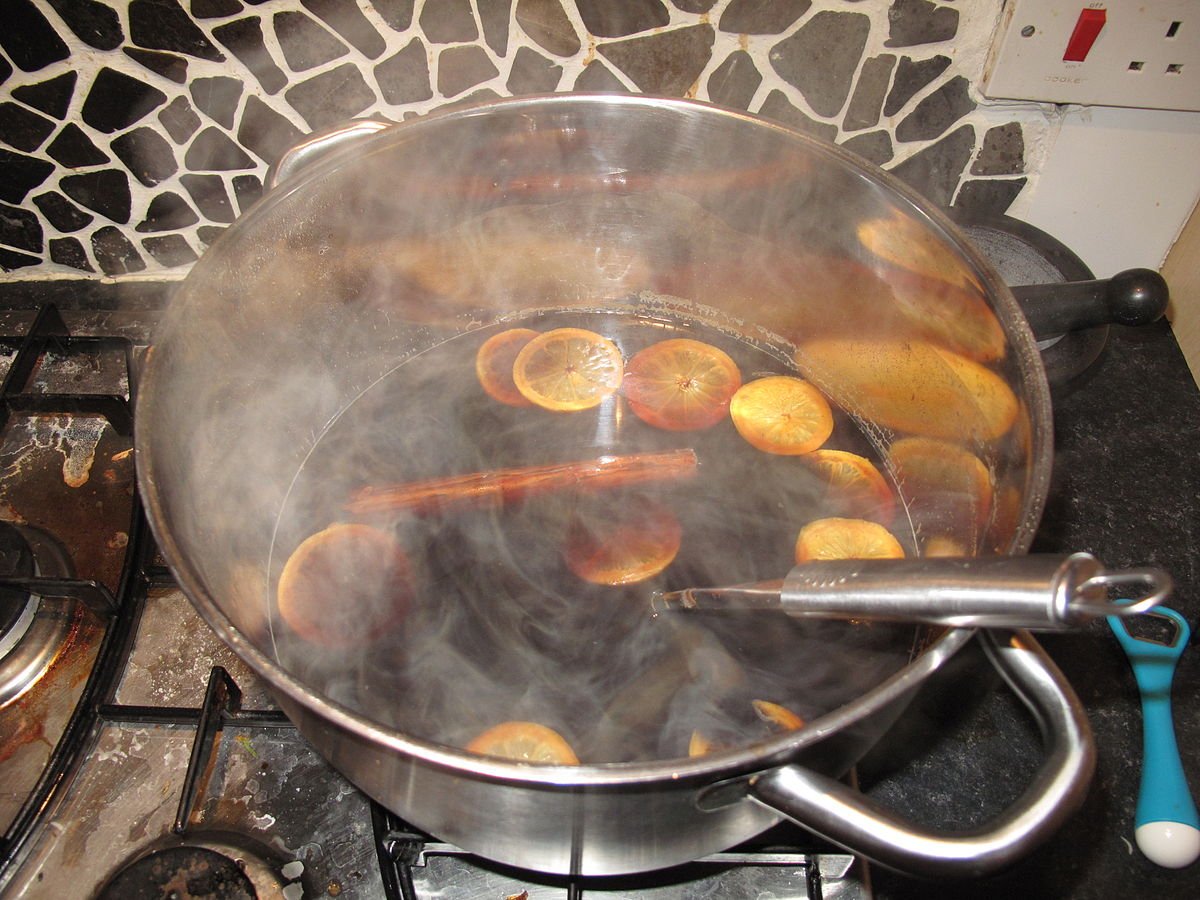
Wassail bowl
Celtic Music
Traditional Celtic folk music is divided into three regions: 1) Gaelic -Irish, Scottish, Manx; 2) Brythonic: Welsh, Cornish, Brittany; 3) Galacia -Spain and Portugal. Scottish and Irish traditional folk music have been popular in Canadian Atlantic provinces Newfoundland, Cape Breton, and Prince Edward Island. In the U.S., predominantly in New England and Appalachia.
There was a revival of Irish folk music in the 1950s and ‘60s with The Clancy Brothers, The Dubliners, The Chieftains, and The Irish Rovers. Scotland had a revival in the 1960s with The Corries, Jackie Levan, The Boys of Lough, and Ewan MacColl.
Celtic music has been popular in the U.S. since 17th Century colonization. It is a mix of Irish and Scottish traditional folk music and dance predominately in Appalachia and New England. American Celtic music evolved into contemporary Americana music, Old Time music, folk music, bluegrass, country, and western. It mixed with African-American blues and gospel. In recent times it mixed with new age, smooth jazz, rock, and world music.
“In Dulci Jubili” carol
A medieval Latin carol from 1328. Performed by the Mediaeval Babes.
“Veni, Veni Emmanuel” hymn
An 8th Century Christmas Latin hymn.
Appalachian bluegrass music has been around for several hundred years. Bluegrass was popularized in the 1940s by Bill Munroe, the duo of Lester Flatt and Earl Scruggs, and the Stanley Brothers. It has a more complex structure of harmonies and melodies than country-western music. Similar to jazz, members each perform solo parts with sophisticated improvisation.
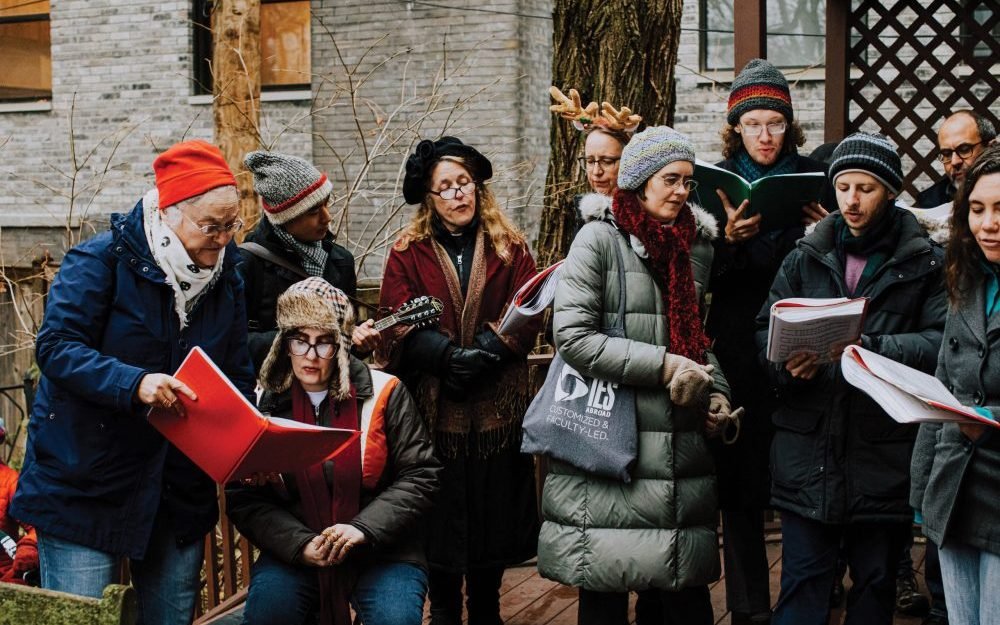
Traditional Christmas wassailing
“Auld Lang Syne” song
A traditional folk ballad with lyrics written by Scottish poet Rpbert Burns. Performed by Highland Saga, a Scottish music group that performs Scottish, Irish, and Celtic music.
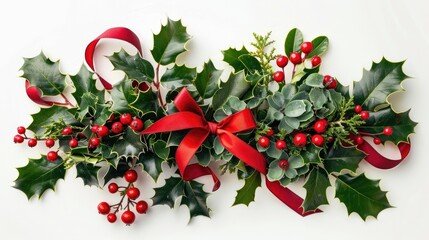
Holly and ivy