
When the universe started leaking observational data that didn’t quite match the sleek stainless-steel sink of the standard Big Bang model, scientists were faced with a choice. Rebuild the plumbing, or reach for the cosmic flex tape, better known as Dark Matter. Just like our polo-clad prophet Phil Swift slapping flex tape over Niagara Falls, the scientific establishment applied an invisible, undetectable, unfalsifiable patch to the cracks in their cosmological theories.
Rather than reimagining the kitchen, they clung to the blueprint, tenure, funding, and fragile egos at stake, and covered the inconsistencies with a theoretical substance that only seems to exist in equations, not in detectors. This isn’t science, it’s a cosmic infomercial, and we’re all audience members clapping on cue. Dark matter isn’t a breakthrough, it’s a branding campaign, a shiny label slapped on to make the cracks in the model look intentional. It’s less like eureka, and more like, act now and receive a second contradiction, free!
The leak, astronomers observed galaxy rotation curves, gravitational lensing, and large-scale structure that screamed, the science community is like, there’s way more mass here than we can see. Mass that wasn’t shining, wasn’t interacting, wasn’t doing anything… except making their precious model look like it had holes.
Born from Fritz Zwicky’s suspiciously accurate 1930s hunch and sanctified by Vera Rubin’s elegant spiral-graph rebellion, dark matter has been retrofitted into the role of cosmic duct tape. But let’s not kid ourselves, it’s less discovery and more dodge, the academic equivalent of blaming ghosts for the dishes flying off your shelves because you’re too scared to admit the house was built on a fault line. We’re not talking about a unified theory here. X
We’re talking about five distinct, gaping wounds, galaxy rotation, lensing anomalies, CMB inconsistencies, cluster velocities, and early structure formation, all stitched together with the same invisible thread. That’s not elegance, that’s linguistic taxidermy. Slap the name, dark matter on a half-dozen problems, and poof. They become one problem, and therefore one solution.
It’s like diagnosing a fever, hallucinations, and your credit score dropping as a cold. It doesn’t heal the patient it just makes the chart look cleaner. And yet, the tape holds. Not because it works, but because it must. The alternatives, modified gravity, a reevaluation of spacetime structure, a heretical poke at the Big Bang itself, require doing the unthinkable, challenging the cathedral. And in the house of cosmology, questioning the foundation isn’t brave, it’s blasphemy. Funding dries up. Tenure committees’ frown. Journal editors ghost you. Far easier to keep layering on the adhesive, praying no one notices that after decades of billion-dollar detectors, dark matter has ghosted us harder than a Tinder match who sees you mention “alternative gravity models.”
What we’ve built isn’t a theory, it’s a sacred patchwork, held together with jargon, reputation, and the collective fear of starting over. But science isn’t supposed to be a safe space for established thought, it’s supposed to be a battlefield of beautiful failures. And right now? We’re not doing science. We’re doing damage control with a glue stick and a grant application. The leak, when reality laughed at our math it started as a whisper, an irreverent, star-forged giggle echoing through the vacuum.
Astronomers, those scholarly somnambulists of the night sky, hunched over their telescopes like accountants trying to balance a celestial budget. They had their equations, their Newtonian abacuses polished and confident the cosmos would stay within the lines. But then, the numbers, started rioting.
At the fringes of spiral galaxies, stars weren’t just rotating, they were dragging racing, tearing through the void with no regard for gravity’s speed limit. According to Newton and his clean, respectable math, they should have been flung off like glitter in a hurricane. But no. They clung, defiant, moving faster than they should, as if an invisible force was holding them in orbit with a raw, unfathomable mass. And just when cosmologists were about to pretend, they hadn’t noticed, gravitational lensing joined in. Light from galaxies billions of years away started curving in ways it shouldn’t, bending space like it was stumbling through a funhouse. Einstein’s math, elegant in its bowtie, shrieked in protest, the lensing was too intense, too warped, like the universe was hiding some colossal, unseen mass behind the curtain, yanking on the strings of spacetime like a back-alley puppeteer. Then came the structure, oh, the structure.
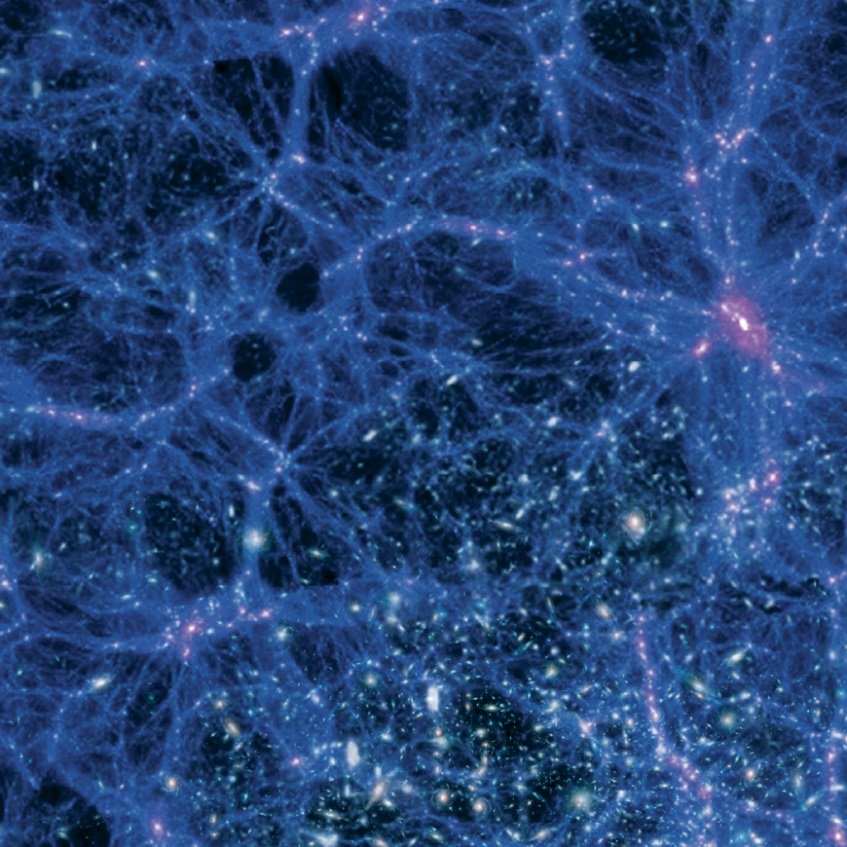
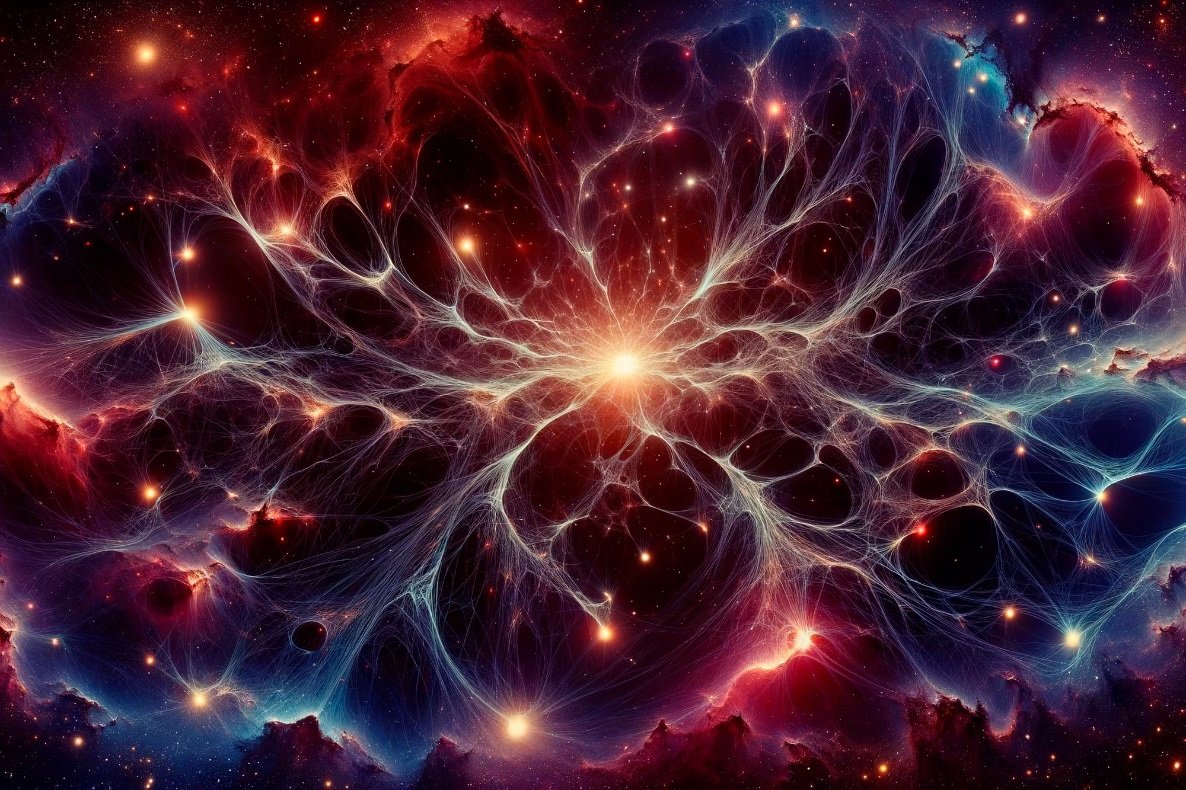
The cosmic web, all clustered galaxies and yawning voids, was too organized, too well-built, too fast. As if some intergalactic contractor skipped the blueprint and just started pouring foundation on Day One. The universe wasn’t evolving slowly from chaos, it was flexing architectural finesse. The universe had more mass than we could see. Not stars. Not gas. Not even a shy neutrino lingering in the wings.
Just, something, silent, heavy and uncooperative. It didn’t glow, it didn’t radiate, it didn’t even acknowledge our presence. But it was there, lurking like a cosmic creditor collecting on a debt we didn’t remember incurring. And the standard model, that gilded monument to 20th-century physics, burnished by Nobel Prizes and held aloft like the Ark of the Theoretical Covenant, sprang leaks. Not polite little drips. Geysers. Ruptures.
Explosions of contradictory data erupting from the pipes of orthodoxy. The plumbing of the cosmos gurgled with questions the model refused to answer. Admit the ship was sinking? Redesign the deck? Pfft. Not a chance. Instead, they reached into the shadows, into the abyss of theoretical convenience, and emerged with a savior made of pure speculation. Dark matter.
The shadow fix. The unseeable hero we didn’t deserve and didn’t understand. The patch, enter, dark matter, the all-purpose, mathematical adhesive. It doesn’t absorb light. It doesn’t emit light. It doesn’t reflect light. It doesn’t interact with ordinary matter. It’s not been directly detected. But damn if it doesn’t solve everything on paper. Cue the spotlight and a slow, dramatic zoom. Enter, dark matter, the universe’s shadiest savior, gliding in like Phil Swift at a black hole auction, armed with a roll of theoretical Flex Tape and the unearned confidence of a messiah in matte-black latex.
No mass-to-light ratio? No problem. No direct detection? Don’t worry about it. It’s the mathematical adhesive of modern cosmology, the duct tape of desperation, it’s here to plug every leak in reality’s leaky script. Let’s be honest, this stuff’s the ultimate ghost. It doesn’t absorb light. Doesn’t emit, reflect, scatter, or so much as brush photons in passing. It doesn’t collide with baryons, doesn’t show up in labs, and certainly doesn’t text back.
It’s the cosmic introvert, lurking at the edge of every equation, too cool to mingle, too essential to ignore. Picture a noir film antihero, invisible trench coat, shadowy past, that has, unresolved issues with gravity. And yet, oh, on paper, it’s perfect. Stars flying too fast? Dark matter’s there, tightening the leash with unseen fingers. Gravitational lensing drunk-dialing Einstein? That’s dark matter behind the curtain, bending space like it’s doing yoga in four dimensions.
Early universe assembling clusters like it’s in a cosmic time-lapse montage? Dark matter again, flexing its mass without ever showing its face. It’s the MVP of theoretical fanfiction, solving everything except the mystery of why we keep pretending we understand the plot. But here’s the kicker, after decades of billion-dollar experiments, we still haven’t found a damn thing. X
And yet, nothing. Just the sound of cosmic crickets… and the hum of another grant application being approved. But does that stop the faithful? Hell no. Dark matter has transcended theory, it’s a doctrine, lovingly whispered in the pews of peer-reviewed journals and murmured over espresso at astrophysics conferences in the Alps. Not because we’ve proven it, oh no, but because without it, the Big Bang model starts to look less like a sink and more like a glittery colander on fire.
Why bother redesigning the plumbing when you can slap on more Flex Tape and call it “precision cosmology”? Why admit the universe might not conform to our models, when you can invent an entire shadow world to make the math behave? It’s cosmology’s ultimate scapegoat, a blank check to maintain the narrative, the tenure, and the illusion of control. But let’s be real, this isn’t a theory. A sleek, academic chant to keep the existential void from screaming too loud. Dark matter isn’t the answer, it’s the avoidance. A beautiful lie, dressed in equations, propped up on grant money and the hope that no one asks what happens if the tape ever fails. And it is failing. Quietly. Slowly. Peel by peel, the data is dripping through. Rotation curves keep side-eyeing our equations like they know the truth.

The truth? The patch won’t hold forever. MOND, The Gravitational Side-Eye Modified Newtonian Dynamics (MOND), proposed by the eternally uninvited but irritatingly persistent Mordehai Milgrom in the 1980s, isn’t trying to burn down the laws of physics, it’s just whispering, “What if gravity changes its behavior at low accelerations?” That’s it. Not “gravity is fake,” not “aliens did it,” but “maybe gravity gets… weird when it’s tired.” And guess what? It works, frighteningly well, when it comes to explaining galaxy rotation curves without invoking invisible mass.
While dark matter apologists are still busy trying to lure WIMPs into traps like cosmic baitfish, MOND just shows up with a pen and says, “I already explained that spiral galaxy back in ’88, darling.” But here’s the rub, MOND doesn’t play nice with the Big Bang’s cathedral architecture. It doesn’t naturally extend to galaxy clusters, or the cosmic microwave background, or large-scale structure, without some heavy massaging. It’s more scalpel than sledgehammer, a local fix rather than a global rewrite, yet somehow, it explains rotation curves better than the current model in many cases with fewer free parameters.
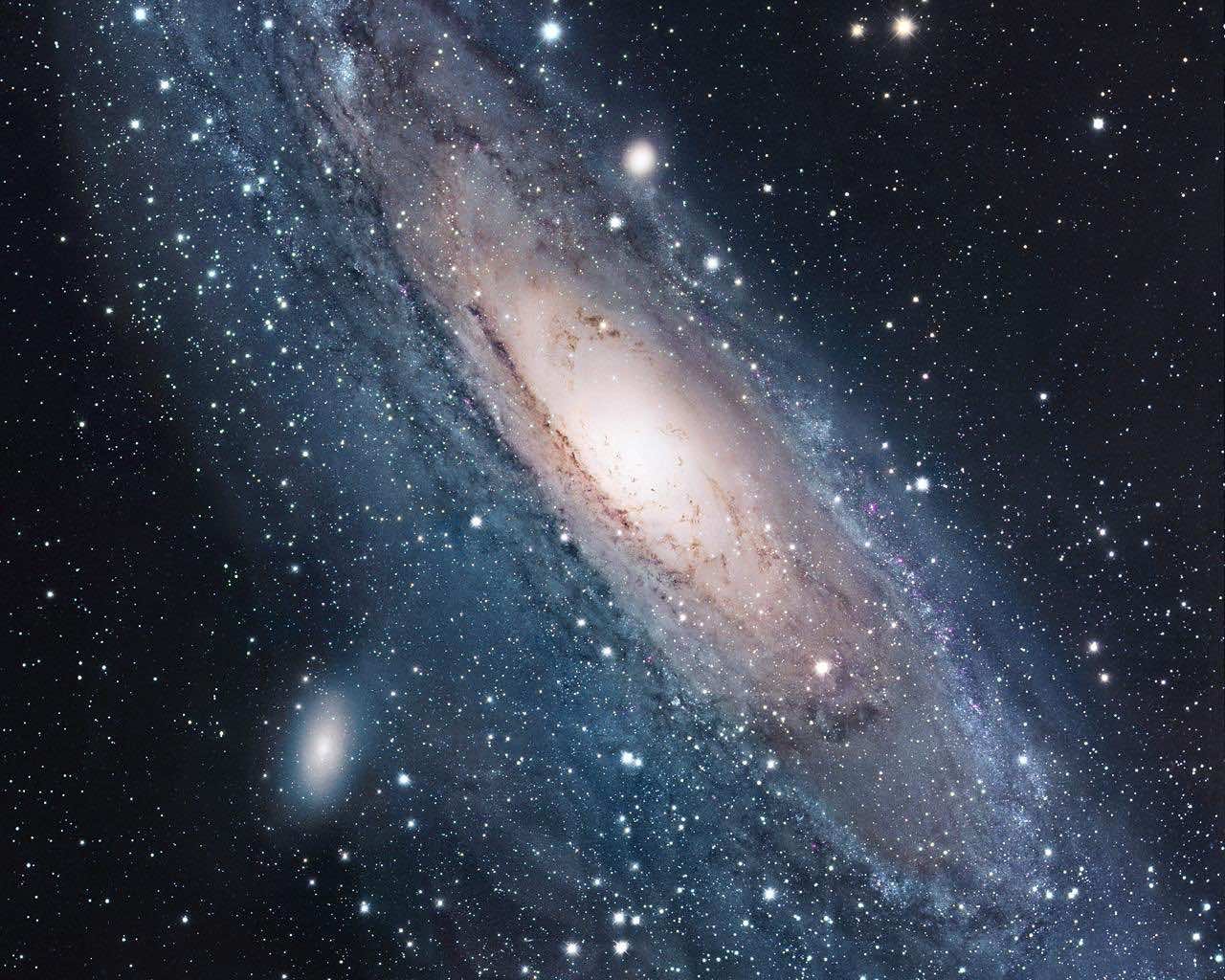
So why the shade? Because MOND dares to question the very form of gravity, which is sacred ground in the temple of general relativity. Changing the gravitational law means possibly rewriting huge swaths of theoretical physics, and let’s be honest, that’s a career death sentence unless you’re Einstein 2.0 with a cult following and tenure that can tank a supercluster. The Dogma: Dark matter became a faith-based placeholder, the Jehovah’s Witness of physics. Not because it’s wrong, oh no, it’s far more sinister than that, but because it’s conveniently unfalsifiable. It fills gaps, protects tenure, and keeps the old cathedral of physics intact.
The Dogma: Dark Matter, the Holy Ghost of a Creaky Cosmos Dark matter isn’t a lie. Lies are brittle, crude, prone to shatter under scrutiny. Dark matter is far more elegant, a creed, a polished placebo wrapped in mathematics and sanctified in the cathedral of consensus. It’s not clumsy, it’s surgical, slipping between the cracks in our equations like incense through a stained-glass window. Think of it as the Holy Ghost of physics, omnipresent, unseeable, invoked in reverence and fear, always just out of reach. Not fake, oh no. That would be merciful.
It’s worse than falsehood; it’s unfalsifiable. A wraith in a lab coat, smiling behind every failed detection like a priest behind confession glass. We can’t see it, hear it, touch it, trap it, but we believe, because to doubt it would mean the gospel has failed. This isn’t discovery, it’s divine misdirection. Dark matter isn’t hiding in a lab; it lives in the margins of our models, in the difference between theory and observation, in the haunting silence between what is and what we think should be.
Stars spin wrong? Space bends too much? Clusters clump like they’ve got somewhere to be? We sketch in the shadow, give it mass, give it mystery, give it meaning. And just like that, ignorance becomes scripture. Dark matter has become the doctrine that defends the model, not explains the universe. It’s the Flex Tape we keep layering over the Big Bang’s rusted pipes, the sacred patch that spares us the theological nightmare of rewriting our origin myth.
It’s not science, it’s theological engineering, safeguarding the celestial machine from collapse, bolting tenure to belief and locking the gates to doubt. To question it is heresy. To doubt it, to whisper that perhaps the equations need rethinking, that maybe our sacred model is a beautiful corpse bloated with epicycles, that’s apostasy. Suggest MOND, or quantum gravity, or pre-Bang cosmologies, and the academic papacy exiles you. Not with fire. With silence.
No keynote. No funding. No eyes. Your papers fade into the void, uncited, unread burden like Gnostic scrolls in the desert of disinterest. So, the rituals continue. Ever-larger detectors hum hymns in frozen caverns. The faithful chant equations in sterile chambers, whispering, just one more experiment, just one more billion-dollar prayer. Axions. Sterile neutrinos.
Every shadow gets a name; every failure gets repackaged as future hope. And still, silence. They know. Oh, they know. Deep in the part of their mind they’ve quarantined from their grant proposals. Dark matter isn’t the explanation, it’s the evasion. It’s a velvet rope keeping the crowd from the edge of the model’s abyss. A cathedral cornerstone poured not from truth but from tradition, warm and glittering, while the stars above cackle in ancient, chaotic laughter.
Look, it’s not all snake oil and duct tape. Dark matter didn’t earn its throne by accident. It’s not clinging to cosmology like a barnacle, it’s there because, for all its ghostliness, it works. Or at least, it has worked well enough. Drop dark matter into an N-body simulation and watch the cosmos bloom. Galaxies form. Clusters clump. Large-scale structure sprawls across the void like a web spun by a divine arachnid.
The ΛCDM model, armed with cold dark matter, isn’t just a shot in the dark, it’s a predictive juggernaut, churning out results that match many of our observations to a frightening degree of precision. The cosmic microwave background? Check. Baryon acoustic oscillations? Got those too. The matter power spectrum?
It lives there. You can almost forgive the particle no-shows when the math keeps nailing the dress code. But here’s the catch, it works because we made it work. We tuned the model, polished it, pampered it, massaged the parameters until the results sang in harmony. And when the notes got discordant? We didn’t question the song, we added another instrument. More dark matter. More epicycles. More theoretical gauze. It’s the best-fit crutch we’ve ever built, a prosthetic limb for our understanding of gravity and structure formation.
And sure, it walks. But let’s not confuse mobility with health. The model is functional, yes. But it’s also stitched together with assumptions and speculation that have grown so sacred we dare not cut them open. So yes, dark matter earns its keep, for now. It props up the stage, keeps the play running, gives the illusion of coherence. But that doesn’t make it truth. It makes it expedient. And when the smoke finally clears, we may realize we weren’t watching a theory, we were watching a performance.
A brilliant, well-funded, impeccably simulated performance. And the universe? It’s backstage, laughing in a language we haven’t learned yet. Conclusion, there’s no cosmic pill, not in medicine, not in the star science, like plumbing, sometimes needs a full renovation. But rather than tearing out the rusted pipes of early 20th-century cosmology, many physicists have become Flex Tape evangelists, patching the leaks with theoretical duct tape and hoping the water pressure doesn’t explode. Picture a doctor peddling a single pill to cure cancer, heartbreak, and a stubbed toe.

In biology, we’d laugh that quack into the street. The body’s a warzone of chaos, feedback loops, rogue cells, hormones staging coups. One fix for all? That’s a punchline, not a prescription. And yet, in cosmology, where the canvas is infinity and the stakes are everything, the high priests have offered us exactly that, a cosmic cure-all for a universe cracking under its own contradictions.
They call it dark matter, the Flex Tape of the cosmos, slapped on with the zeal of televangelists and the precision of late-night infomercials. Galaxies spinning like carnival rides? Dark matter’s the leash. Dark matter’s the backup dancer.
CMB humming off-key? Dark matter takes the mic. Galaxy clusters hiding mass like skeletons in an attic? That’s just more shadow glue. Five problems, one patch, zero proof. If this were medicine, it’d be malpractice. If it were engineering, it’d be a meme. But in cosmology? It’s dogma, scripture masquerading as theory, chanted in grant proposals and institutional hymns. Decades of ghost-hunting, axions, sterile neutrinos, and still the scoreboard reads, cosmic crickets.
But belief holds, not because it works, but because it saves the model. It saves the machine. And sometimes, science becomes a cathedral, propping up placebos to spare egos, reputations, and carefully mortgaged legacies. Dark matter’s no answer, it’s a closet where we’ve swept every contradiction, slapped the same name on the mess, and called it a unified theory. Rotation curves may crave new gravity. Lensing might whisper hidden laws. Structure might scream an older, stranger, uncooperative cosmos. But give it a name, say it loud enough, and suddenly the mystery sounds like mastery. We didn’t solve the puzzle.
We named the hole and built shrines around it. Real science doesn’t tape over the leaks, it rips up the foundation, hunts the rot, and builds something better. Even if it means burning the blueprints. Even if it means dragging the high priests out of their echo chambers and into the storm. Dark matter isn’t the monster. It’s the cage we locked our questions in. A comfort blanket sewn from denial. And the universe? It’s not leaking. It’s howling, mocking our patchwork prayers and daring us to wade into the chaos, no tape, no gospel, just raw, wild truth.
References
Kroupa, P. (2012). “The Dark Matter Crisis: Falsification of the Current Standard Model of Cosmology.” Publications of the Astronomical Society of Australia, 29(4), 395–433.
McGaugh, S. S. (2015). “A Tale of Two Paradigms: The Mutual Incommensurability of ΛCDM and MOND.” Canadian Journal of Physics, 93(2), 250–259.
Merritt, D. (2020). A Philosophical Approach to MOND: Assessing the Milgromian Research Program in Cosmology. Cambridge University Press.
Aprile, E., et al. (2018). “Dark Matter Search Results from a One Tonne-Year Exposure of XENON1T.”
Akerib, D. S., et al. (2017). “Results from a Search for Dark Matter in the Complete LUX Exposure.”
Kuhn, T. S. (1962). The Structure of Scientific Revolutions. University of Chicago Press.
Sanders, R. H. (2014). “A Historical Perspective on Modified Newtonian Dynamics.” Monthly Notices of the Royal Astronomical Society.
Kochin, M. (2023). “Stress Testing ΛCDM with High-Redshift Galaxy Candidates from JWST. “Nature Astronomy, 7, 731–735.
Van Dockkum, R., et al. (2018). “A Galaxy Lacking Dark Matter.” Nature, 555, 629–632.
Famaey, B., & McGaugh, S. S. (2012). “Modified Newtonian Dynamics (MOND): Observational Phenomenology and Relativistic Extensions.” Living Reviews in Relativity.
Hossenfelder, S. (2018). Lost in Math: How Beauty Leads Physics Astray. Basic Books.


