The klaxon sounded.
An exasperated Mrs. Dibb put on a reassuring face and convinced her kindergarten class, me included, to ball ourselves into fetal positions beneath our desks.
This, she informed us in a hushed tone – as if her volume could summon The Bomb itself – would spare us the nightmare of a nuclear holocaust.
In a way, she was right. If a nuke came our way, we wouldn’t suffer an apocalypse. We would become its first charred victims. Neither our flimsy Formica desks nor our sturdy brick school were a match for The Bomb. But the joke was on us. Duck and cover would go on to save exactly zero lives. It would, however, help perpetuate one of the most incongruent aspects of human nature: the crazier the story, the more likely we are to believe it’s true.
History is replete with examples, but alarmingly, so is the present. Whether discussing the quantum computers, artificial intelligence, or nuclear proliferation, humankind’s first response to new technology – to anything new, really – is fear. If someone is afraid of the dark, you bring them a night light. If they’re afraid of heights, you make sure they get the aisle seat on the airplane. Then, it follows that the best way to snap someone out of their terrors is to give them a good laugh. Which brings us to today’s film…
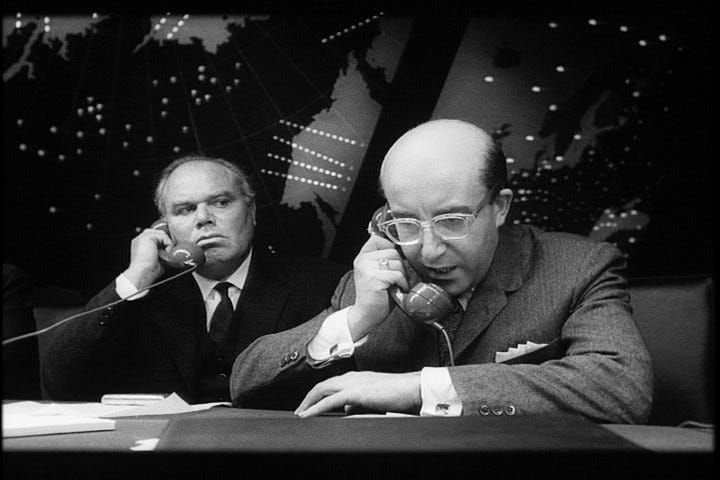
Russian ambassador and U.S. President on the phone with Moscow
Directed by deceased auteur Stanly Kubrick, Dr. Strangelove: Or, How I Learned To Stop Worrying And Love the Bomb, this film holds a mirror to the face of mankind and asks the critical question: are you dumb enough to destroy yourselves? The answer, counterintuitively, is yes. Released in 1964, the film presents a sharp critique of cold war logic and the detached, cold-hearted men who sought to crank up the temperature of the ongoing game of global one-upmanship. The film is memorable for more than a few reasons; it’s modern-day relevance notwithstanding…
Dr. Strangelove is the story of a conspiracy-minded general who orders a preemptive nuclear attack on the Soviet Union. Unbeknownst to everyone, if even a single nuke reached its target, a secret Soviet doomsday device would automatically shroud the world in a nuclear winter lasting ninety-three years. Once this doomsday device is revealed, the American President triggers a mad rush to recall the bombers before they reached their targets. Despite their frantic attempts, a single bomber slips the net with a chance of reaching its primary target.
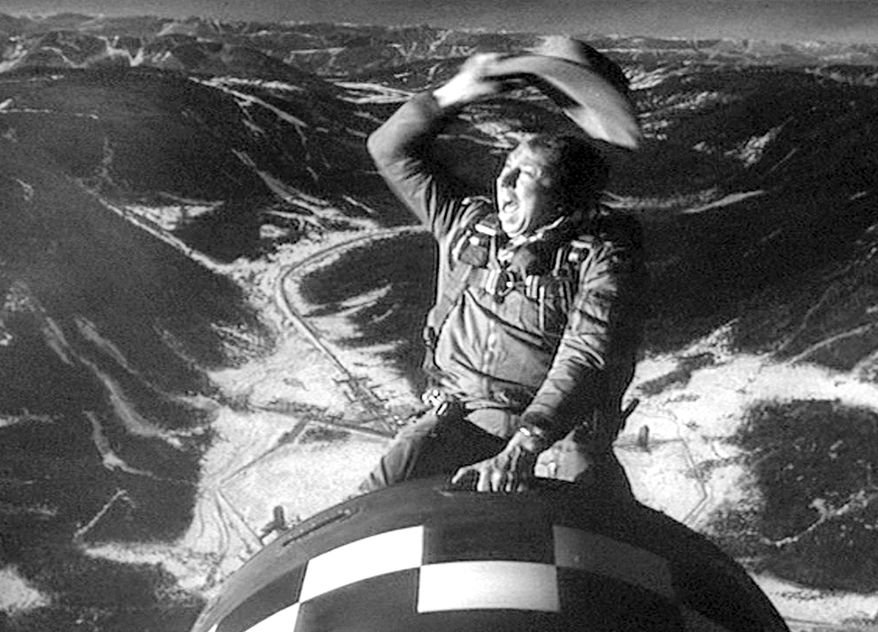
Slim Pickens riding the bomb
All of this is explained to President Merkin Muffley (played by Peter Sellers) by the Russian ambassador, who brokers a call between the President and the Premier, in the American War Room. Both men take decidedly childish stands against each other, including arguing over who is sorrier about the present situation. The ambassador goes on to say that they “could no longer afford the space race, the arms race, and the peace race. Something had to give!” The economical solution was a doomsday device that cost but a tenth of the annual military budget.
Amist this repartee, General Turgidson (played by George C. Scott) gets into a row with the Russian ambassador that won’t be stopped until the president screams the most famous line of the film, “No fighting in the war room!”
Eventually, everyone turns to Dr. Strangelove for answers. The title character not appearing until the middle of the movie seems odd until you realize just how strange he really is. He’s a mixture of mad scientist and the pragmatic Nazi monsters who directed his research from their ivory towers (his words). If that doesn’t make you blink twice, Kubrick painted an unforgettable physical character. He is wheelchair-bound (until the end of the movie when he miraculously walks), dressed in black leather looking suspiciously like those Hugo Boss Nazi uniforms, wore sunglasses indoors, and possessed a violent case of alien hand syndrome that caused him to give the Nazi salute at the most inopportune times.
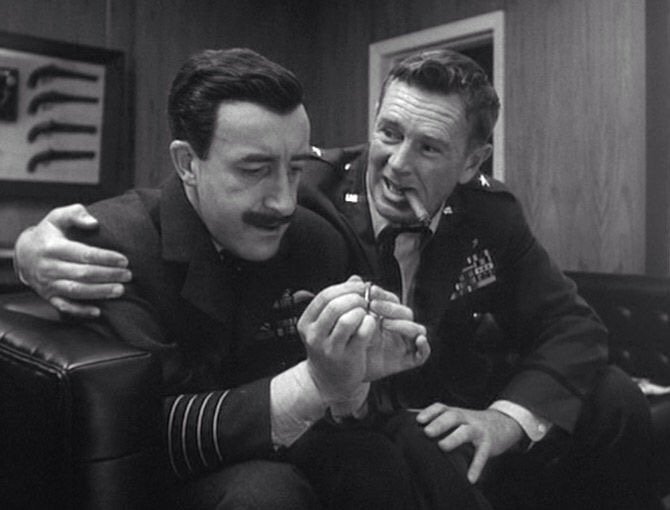
Peter Sellers and Sterling Hayden saving our precious bodily fluids
As they debate their dwindling options, the “big board” shows that the majority of the B-52s were recalled and four were shot down. However, one rogue aircraft failed to answer the recall signal. The Doomsday scenario was getting closer by the minute. The doorbell rang. Mutually assured destruction at the door…
Everyone turns to Dr. Strangelove for reassurance, for a rational, scientific way out of this mess of their own making. Instead, he admonishes the Russians for building a Doomsday device and not telling anybody about it “because otherwise it will not work!” He goes on to present the idea of a new world where people live and reproduce underground until the surface is safe again.
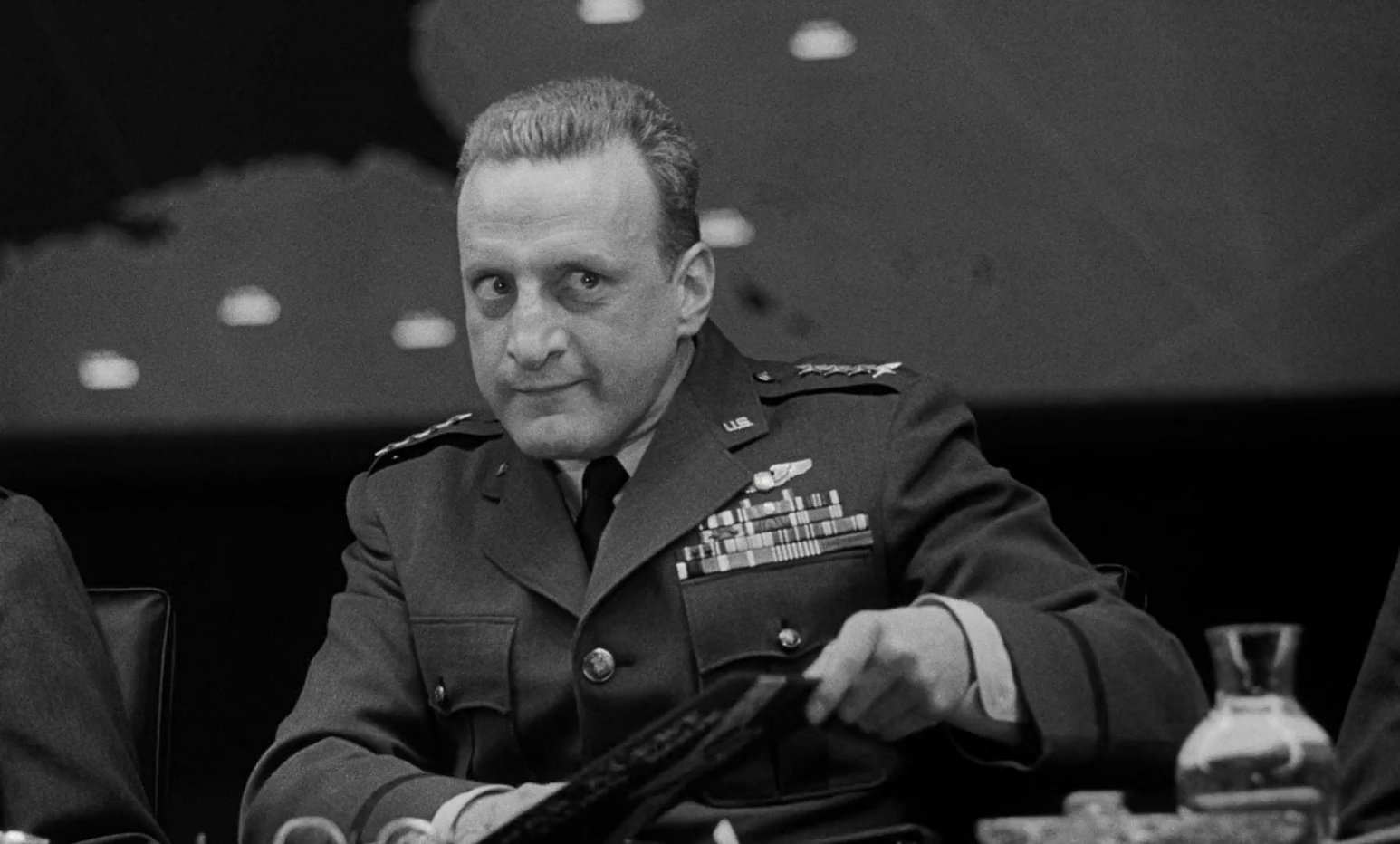
George C. Scott
While the military and politicians pepper Dr. Strangelove with questions, the B-52 has finally reached its final target…and the viewer is subject to archival footage of nuclear explosions to the tune of Dame Vera Lynn’s “We’ll Meet Again.”
In a world that eschews unhappy endings, Kubrick does everything possible to make the idea of mutually assured destruction sound both terrifying and, dare I say, silly? While this makes for great satire, it’s also a call NOT to lose our humanity in the face of the god-like powers we’ve discovered for ourselves. Of course, there are as many different versions of humanity as there are people who have given it thought. Who will decide what is considered normal or human or culturally acceptable when we can’t even agree on our commonalities?
Enter AI. The nuclear bomb of the late Anthropocene Age. Polls on this have been conclusive. A national Quinnipiac University Poll found that 73% of Americans are concerned that artificial intelligence poses a potential threat to human survival (thanks for the stat, Gemini!). Two thirds of those folks believe the threat will be existential. Today we have AI agents breaching message boards, financial institutions, and even governments at the direction of bad actors.
Like nuclear technology, we may at first not see the many benefits for the cost of data centers. In the 1940s, when people thought about nuclear anything, they thought about The Bomb that took out Hiroshima and Nagasaki. Fast forward thirty years and that same group of people will see that nuclear technology produces nearly unlimited energy for every country that takes the time and expense to go carefully into the atom smashing business.
I don’t have a dog in the singularity hunt, but I can imagine a world where I get paid the same amount of money and still get to spend more time with my family, exercising, reading, and generally not worrying about Sky Net. Perhaps this article should be retitled “Copywriter, Or How I Learned to Stop Worrying and Love AI.”
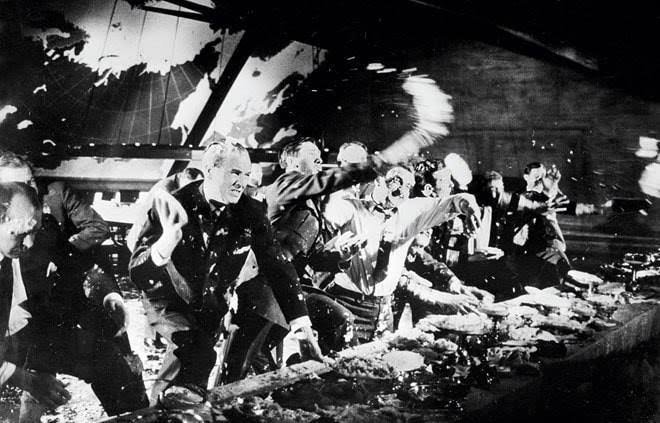
Pie fight cut from the movie