The Season of the City
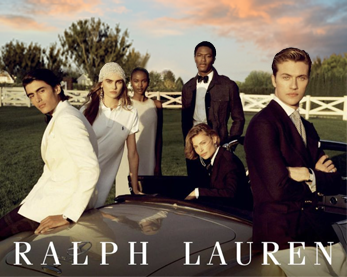
There are cities associated with seasons, and then there is New York in Autumn. Spring softens its edges; summer spills onto its sidewalks; winter crowns it with snow and the theater of Christmas. Autumn brings a different distinction. The air sharpens, the afternoon light settles against limestone façades, and Central Park begins its passage from green to copper, amber, and gold. Wool replaces linen. Coats return to the backs of café chairs. Behind restaurant windows, lamps glow before dinner, and the city renews its appetite for conversation, music, and the pleasure of an evening out.
To call this merely a change of weather would be to miss its influence on the imagination. “Autumn in New York” has become a song, a jazz standard, a film title, and a promise carried by people who may never have walked its avenues. The words evoke romance touched by melancholy, elegance made more compelling by imperfection, and the hope that an ordinary day might still open onto an extraordinary encounter. Autumn lends Manhattan a rare intimacy and for a moment, a city of millions seems capable of belonging to two people.
Where “Autumn in New York” Begins
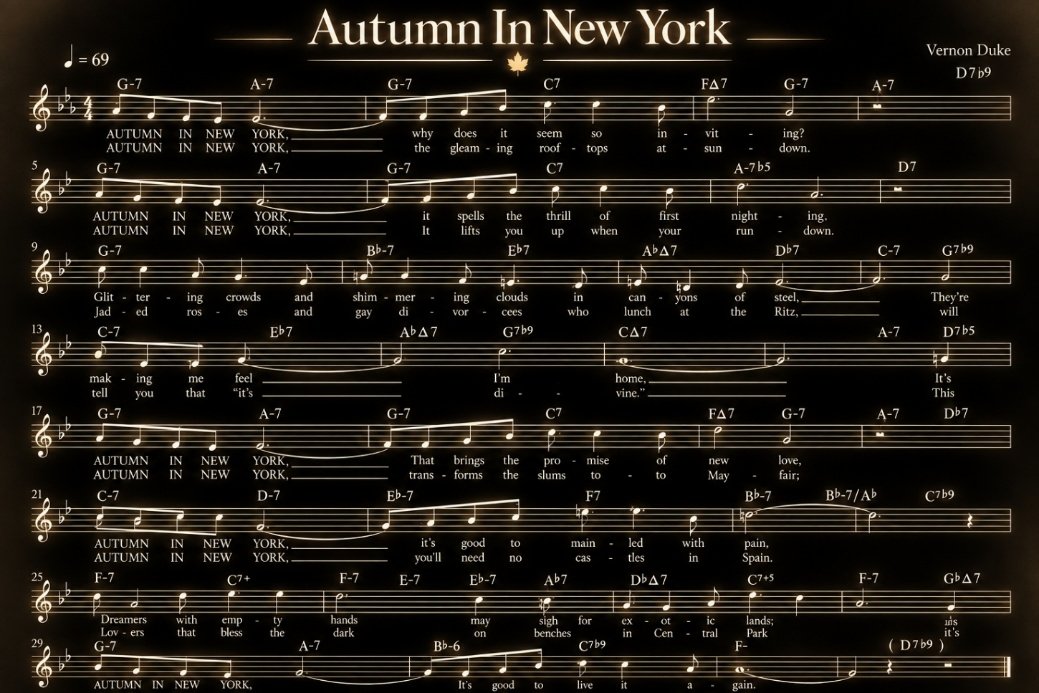
The phrase found its enduring musical expression in Vernon Duke, the composer born Vladimir Dukelsky, whose career encompassed both classical music and Broadway. In the summer of 1934, while staying in Westport, Connecticut, he began writing out of longing for Manhattan. The idea took shape as poetry before becoming a song. Duke supplied both words and music, and “Autumn in New York” entered his Broadway show “Thumbs Up!” which opened that December. A work inspired by absence would become one of the city’s most evocative musical portraits.
Its distinction lies in the emotional range of that portrait. Duke gives us a metropolis of attraction and disappointment, where the prospect of love exists alongside the knowledge of loss. The melody allows those feelings to coexist, moving with a grace that invites reflection rather than demanding reassurance. This is romance with an adult understanding of uncertainty. The song recognizes that a city can exhilarate and exhaust us, that beauty does not protect us from loneliness, and that longing sometimes reveals a place more clearly than familiarity ever could.
A Song Becomes a Standard
From Broadway, “Autumn in New York” gradually entered the Great American Songbook, finding a second life through performers who could draw out its shifting emotions. Frank Sinatra’s Columbia recording, made in 1947 with an arrangement by Axel Stordahl, helped bring it to a wider audience. Billie Holiday, Ella Fitzgerald, Louis Armstrong, and later Diana Krall would each give the song a distinct vocal character. Its survival depends less on a definitive performance than on this openness to interpretation. The same composition can sound hopeful one evening and quietly wounded the next.
Diana Krall, “Autumn In New York”
Listening across these performances reveals the song’s capacity for intimacy. To this listener, Sinatra brings youthful yearning beneath the orchestral polish, while Holiday makes its tenderness feel searching and exposed. On the 1957 album “Ella and Louis Again”, Fitzgerald’s luminous phrasing and Armstrong’s grainy warmth give the duet the character of a conversation. Krall’s 2020 interpretation on the “This Dream of You” album offers another kind of closeness, drawing the listener toward the space around the melody. These are different encounters with the same emotional landscape. Each reminds us that a standard belongs to successive generations because it leaves something for them to discover.
Other notable vocal recordings include the singers Jo Stafford, Sarah Vaughan, Lena Horne, Chet Baker, Johnny Mathis, and Harry Connick Jr.
Why the City Looks Different in Fall
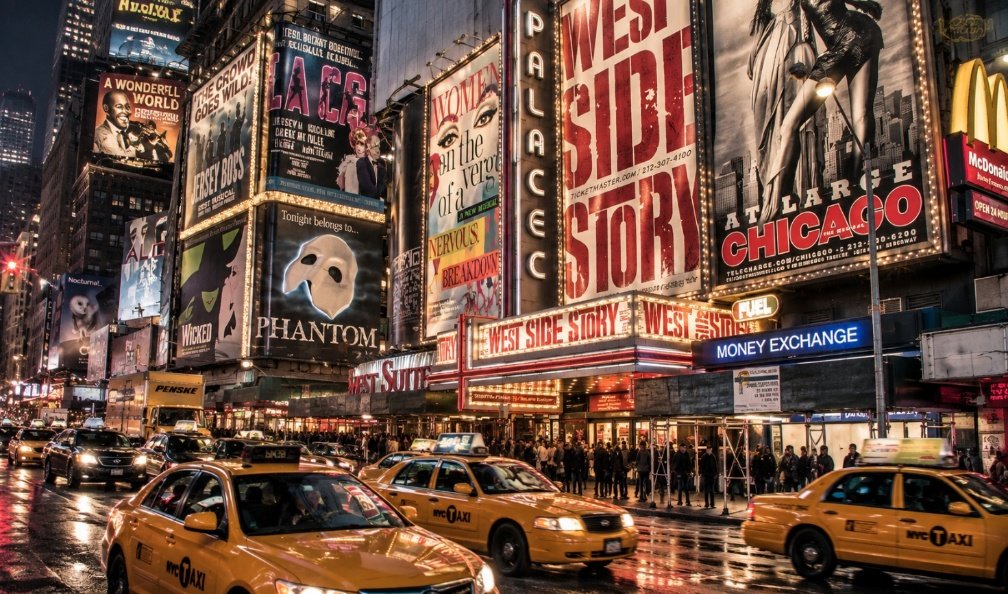
New York in fall is as much a visual language as a geography. Amber leaves gather at the foot of brownstone steps. A dark coat passes beneath a pale stone arch. Rain turns an intersection into a shifting reflection of headlights and windows. The low afternoon sun catches the upper floors of buildings while the street below has already entered shadow. Such contrasts make familiar places appear newly composed, inviting the eye to linger on details that the haste of summer might have concealed.
Frank Sinatra, “It Had to Be You”
The season also lends dressing a renewed sense of occasion. A well-cut jacket, a satin scarf, or the quiet sheen of leather, these belong to the city’s autumn wardrobe as surely as its changing trees. Elegance here is a matter of attention. It can be found in how someone carries a coat, arranges a table, or pauses to greet a neighbor. Against Manhattan’s scale and speed, these small gestures create proportion. They suggest that even a crowded day can accommodate care, and that daily life deserves a measure of ceremony.

Central Park and the Romance of Passing Time
Central Park gives this seasonal transformation its most expansive expression. Designed by Frederick Law Olmsted and Calvert Vaux, whose Greensward plan won the 1858 competition, the park was conceived as a place of respite and public enjoyment. Its apparent naturalness is an achievement of design open landscapes, wooded paths, and carefully composed views provide relief from the surrounding streets. In autumn, that design becomes especially beautiful. A bend in a path reveals another color, a clearing opens onto water as the skyline appears and disappears beyond the trees.
Rosemary Clooney and Benny Goodman, “Memories of You”
Along the Mall, beneath the elms or beside the Lake near Bow Bridge, the city acquires a different measure of time. Buildings mark ambition and endurance, leaves mark change. A walk allows both to be held in view. The park’s romance comes partly from this balance, offering a feeling of seclusion without disconnection to Manhattan. Two people can share an afternoon beneath turning branches while towers rise beyond them. Nothing about the scene promises permanence. Its tenderness comes from the knowledge that this particular conversation and season will pass.
When Hollywood Fell for New York in Autumn
Cinema has long understood how readily New York’s streets can carry emotional meaning. An apartment window suggests a private life within the crowd. A café offers shelter and the possibility of conversation. A park path creates room for an encounter that might otherwise be lost in traffic. Autumn intensifies these settings by making change visible. Before a character speaks, the landscape can prepare us for a departure, a discovery, or the unsettling possibility of falling in love.
Ella Fitzgerald, “My Funny Valentine”
Ella Fitzgerald My Funny Valentine High Quality Remastered
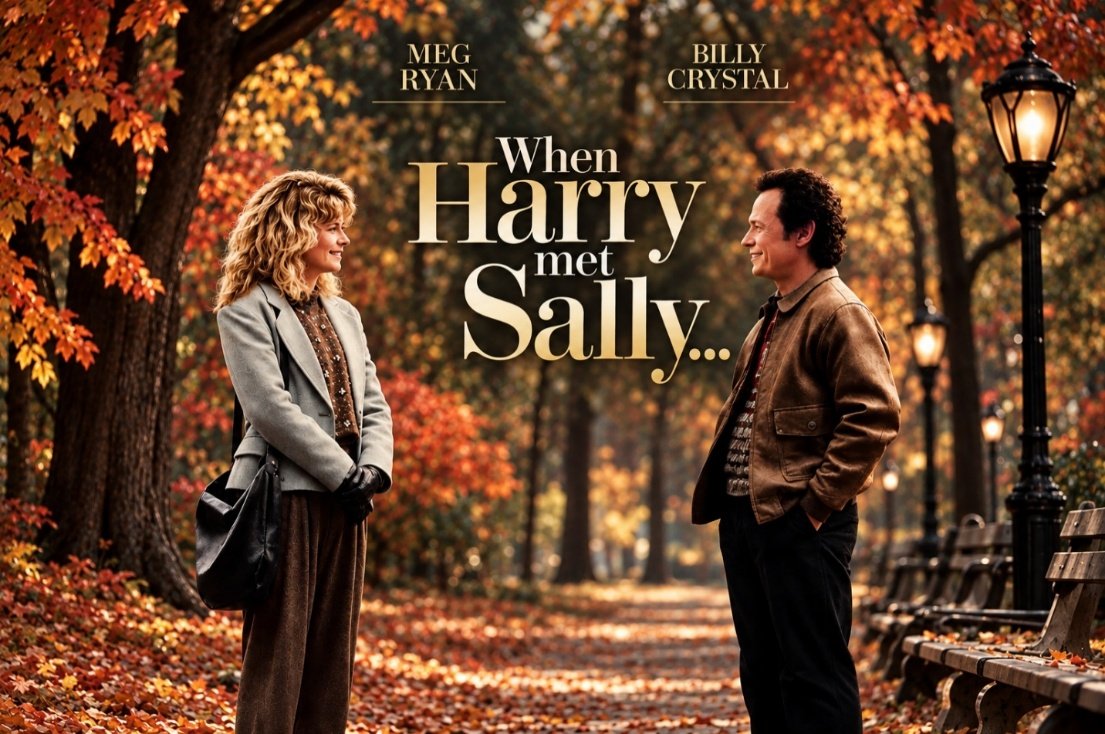
The wider mythology of romantic Manhattan stretches across films as different as Breakfast at Tiffany’s, The Apartment, Manhattan, You’ve Got Mail, Serendipity, An Affair to Remember, and Barefoot in The Park. Their moods range from sparkling comedy to loneliness and compromise, reminding us that the city’s allure has never belonged solely to uncomplicated happiness. When Harry Met Sally, makes particularly memorable use of autumn in Central Park, allowing friendship and desire to unfold against the warmth of changing leaves. Together, such films have taught audiences to read New York as a place where public bustle and private feeling remain in constant conversation.
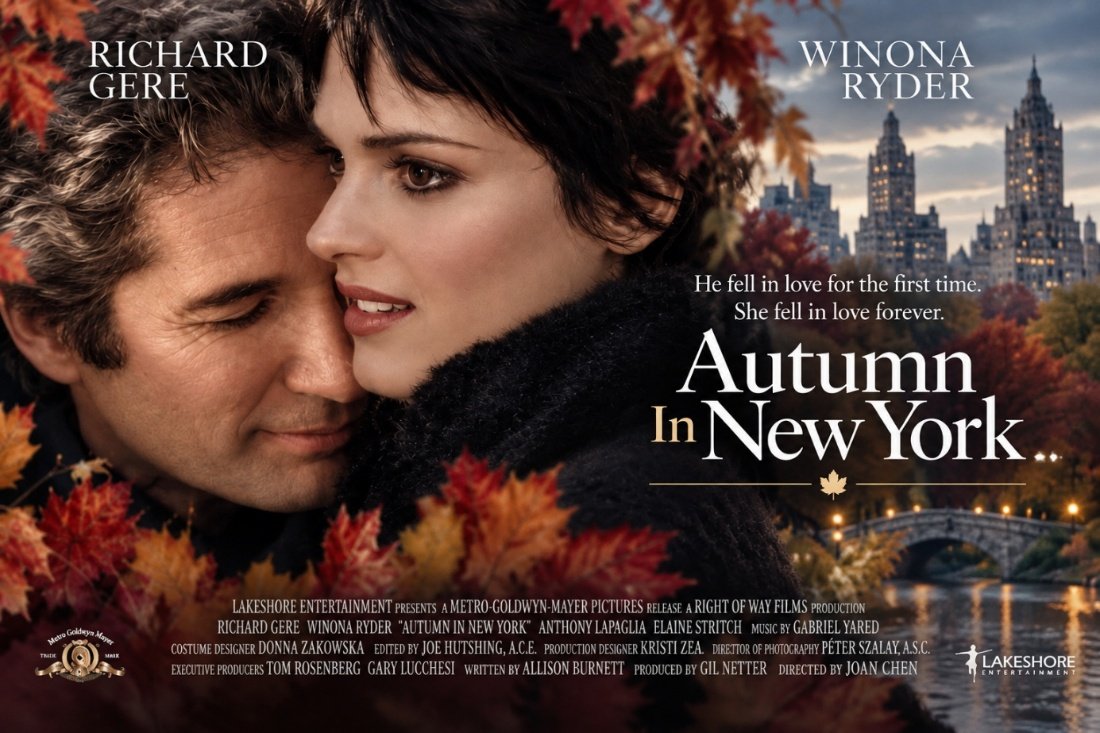
The Film Called Autumn in New York
In 2000, Joan Chen’s “Autumn in New York” gave the phrase a new cinematic life. Richard Gere plays Will Keane, a successful restaurateur practiced in avoiding lasting attachment. Winona Ryder plays Charlotte Fielding, a younger woman whose serious illness alters the terms of their romance. Their relationship unfolds within an idealized Manhattan of restaurants, parks, and softly illuminated interiors. The setting is central to the film’s appeal, making the city’s beauty inseparable from the lovers’ awareness that their time together is uncertain.
The seasonal metaphor is direct, and the film embraces the conventions of romantic melodrama. Yet its imagery addresses a question that reaches beyond those conventions, how does the knowledge of an ending change the way we inhabit the present? Charlotte’s illness gives the autumn landscape a particular poignancy, while Will’s emotional distance becomes increasingly difficult to sustain. The film’s New York is a place in which pleasure acquires consequence. A dinner, a walk, or a shared glance matters because another cannot be taken for granted.
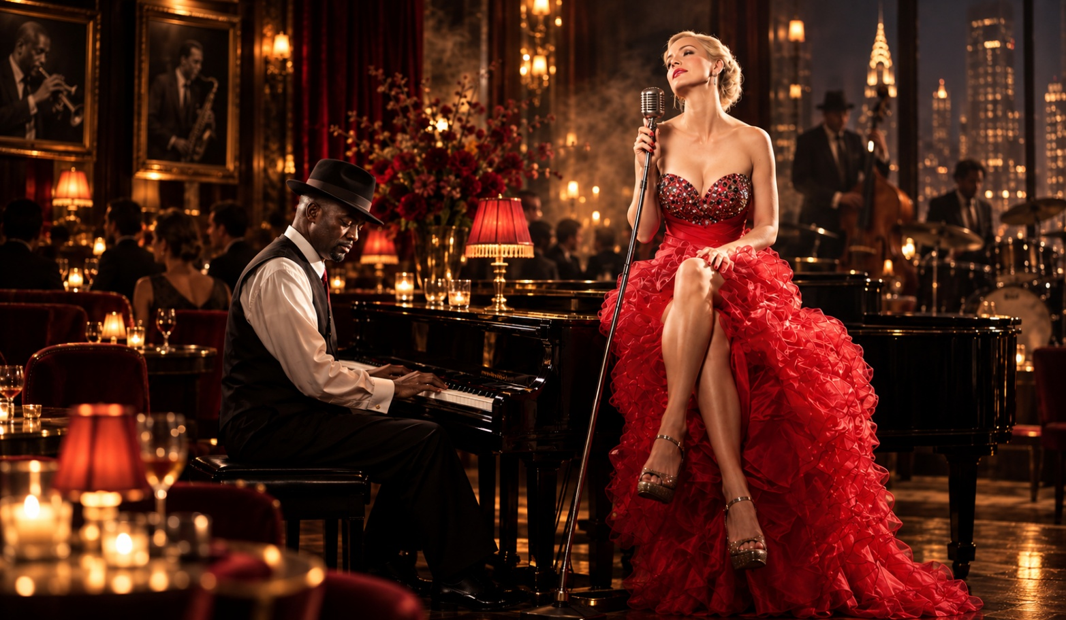
The Music of Manhattan in Fall
Jazz offers another way of inhabiting the city’s autumn mood. Its relationship to New York extends well beyond a seasonal soundtrack, but a ballad heard after dark can seem to gather the evening around it. In “Autumn in New York,” the measured unfolding of the melody leaves room for hesitation, anticipation, and memory. The song invites close listening. A voice entering softly, a phrase held a fraction longer, or a piano answering in the space between lines can change the emotional temperature of the room.
Tony Bennett, “The Very Thought of You”
That balance between structure and freedom suits Manhattan. The avenues establish a pattern, the lives moving through them continually alter it. Jazz works within a similar tension, returning to familiar material while making each encounter distinct. A standard survives because musicians continue to discover possibilities within it, much as a city remains compelling because its history never entirely determines its next chapter. The pleasure lies in recognition touched by surprise, we know the melody, or believe we know the street, until a new interpretation makes us listen or look again.

Library Bar at The Nomad Hotel
The Romance of Ordinary Things
For all its famous landmarks, New York often becomes most personal through modest encounters. A newspaper folded beside a coffee cup. A bookstore window at dusk. The sound of a door closing behind someone arriving from the cold. A couple sharing an umbrella, adjusting their steps to one another as they cross the street. These scenes have little of the grandeur associated with Manhattan, yet they furnish the memories through which a place becomes intimate.
Steve Tyrell, “The Way You Look Tonight”
Autumn encourages that intimacy by drawing attention to shelter, warmth, and companionship. The table near the window becomes desirable because it holds both the interior and the street in view. A familiar café becomes a small refuge. A walk without an itinerary becomes a way of noticing. This is perhaps the season’s most accessible luxury, the permission to be fully present. One need not inhabit the city’s most celebrated rooms to enjoy its romance. Sometimes it begins with enough time to sit, look outward, and let a conversation take its own course.
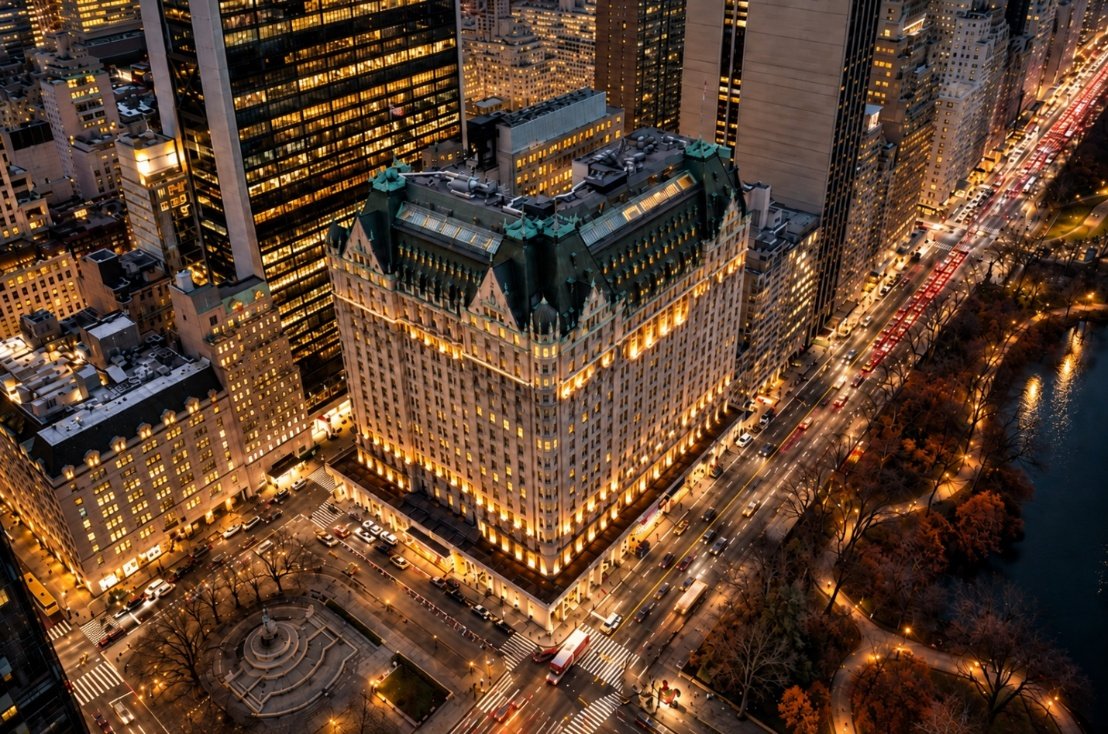
The Plaza Hotel
The Return of Evening
As daylight recedes, evening regains a sense of occasion. The interval between an ordinary afternoon and a night out becomes a small ritual, closing a book, changing a shirt, choosing a coat, deciding to leave the apartment. Anticipation gives shape to the hours ahead. Whether the destination is a theater, restaurant, or a friend’s table, the act of preparing acknowledges that shared time deserves care.
Jo Stafford, “Haunted Heart”
The pleasures are familiar polished wood, the weight of a linen napkin, a lamp that illuminates faces without overwhelming them, the reassuring hum of a room in which conversation is possible. New York’s celebrated hotels and dining rooms have helped sustain this ideal of hospitality, but its meaning reaches beyond luxury. A well-made evening depends on welcome and attention. Autumn gives those qualities renewed appeal. Outside, the city presses forward and inside a table for two can briefly become a world of its own.

Why the Romance Endures
The romance of Autumn in New York endures because it accommodates the city’s contradictions without resolving them. Manhattan can be expensive, exhausting, and indifferent. Its crowds do not guarantee companionship, and its beauty does not erase the difficulty of living there. Yet aspiration persists in the spaces between those realities, in a chance meeting, a creative ambition, a friendship deepened over dinner or a song heard at precisely the right moment. Autumn sharpens our awareness of such possibilities because its moment asks to be noticed before it disappears.
Billie Holiday, “I’ll Be Seeing You”
With a greater sense of what deserves our time, the leaves gather beside the paths in Central Park and evening settles over the Manhattan avenues. Somewhere, a piano begins to play a familiar standard and the listener hears something in it that had escaped notice before. This is Autumn in New York.
Works Cited
American Film Institute. “Autumn in New York (2000).” AFI Catalog of Feature Films. https://catalog.afi.com/Catalog/moviedetails/60976. Accessed 8 Oct. 2026.
American Film Institute. “When Harry Met Sally… (1989).” AFI Catalog of Feature Films. https://catalog.afi.com/Catalog/MovieDetails/58353. Accessed 8 Oct. 2026.
The Broadway League. “Thumbs Up!” Internet Broadway Database. https://www.ibdb.com/broadway-production/thumbs-up-11195. Accessed 8 Oct. 2026.
Central Park Conservancy. “Park History.” https://www.centralparknyc.org/park-history. Accessed 8 Oct. 2026.
Fitzgerald, Ella, and Louis Armstrong. “Autumn in New York.” Ella and Louis Again, Verve Records, 1957.
Jazz Discography. “Frank Sinatra: The Columbia Years — 1947–1949.” Recording session of 4 Dec. 1947, “Autumn in New York,” arranged by Axel Stordahl. https://jazzdiscography.com/Artists/Sinatra/columbia2.php. Accessed 8 Oct. 2026.
Kang, Tricia. “160 Years of Central Park: A Brief History.” Central Park Conservancy, 1 June 2017. https://www.centralparknyc.org/articles/central-park-history. Accessed 8 Oct. 2026.
Krall, Diana. “Autumn in New York.” This Dream of You, Verve Records, 2020.
Silver, Matt. “‘Autumn in New York’—The Story Behind the Standard.” WRTI, 22 Nov. 2021. https://www.wrti.org/arts-desk/2021-11-22/autumn-in-new-york-the-story-behind-the-standard. Accessed 8 Oct. 2026.
uDiscover Team. “Louis Armstrong & Ella Fitzgerald — Ella and Louis Again (1957).” uDiscover Music, 23 July 2022, updated 23 July 2024. https://www.udiscovermusic.com/louis-armstrong/louis-armstrong-ella-and-louis-again-album/. Accessed 8 Oct. 2026.
Universal Music Canada. “Diana Krall Releases This Dream of You, New Album Available Worldwide Now.” 25 Sept. 2020. https://www.universalmusic.ca/2020/09/25/diana-krall-releases-this-dream-of-you/. Accessed 8 Oct. 2026.