There is a fascinating story—or rather, a series of stories—about the British blues scene that I’d love to share. First and foremost, let’s be clear: the blues didn’t originate in the rolling hills of the English countryside. This deeply expressive and soul-stirring genre was born in the American South, where people used music as a means of coping with hardship, joy, sorrow, and the complexities of daily life. The blues was—and still is—a reflection of social and personal struggles, a form of storytelling that speaks directly to the human experience.
In Britain, life’s struggles were different from those faced in the American South, but hardship existed nonetheless. When early recordings of blues artists from the U.S., many of them Black musicians, made their way across the Atlantic, they resonated with British listeners and musicians alike. There was something raw and real in the music that struck a chord. It didn’t take long for British musicians to put their own spin on this deeply moving style, shaping what would become known as the British blues scene.
One of the most significant figures in pioneering British blues was Alexis Korner. During the 1950s, Korner was instrumental in using blues as a foundation for a new wave of music in Britain. In 1961, he co-founded a band called Blues Incorporated, which became a breeding ground for some of the greatest British musicians of the era. The lineup featured, at various points, future stars such as Rod Stewart, Keith Richards, Brian Jones, Mick Jagger, Jimmy Page, and Ginger Baker.
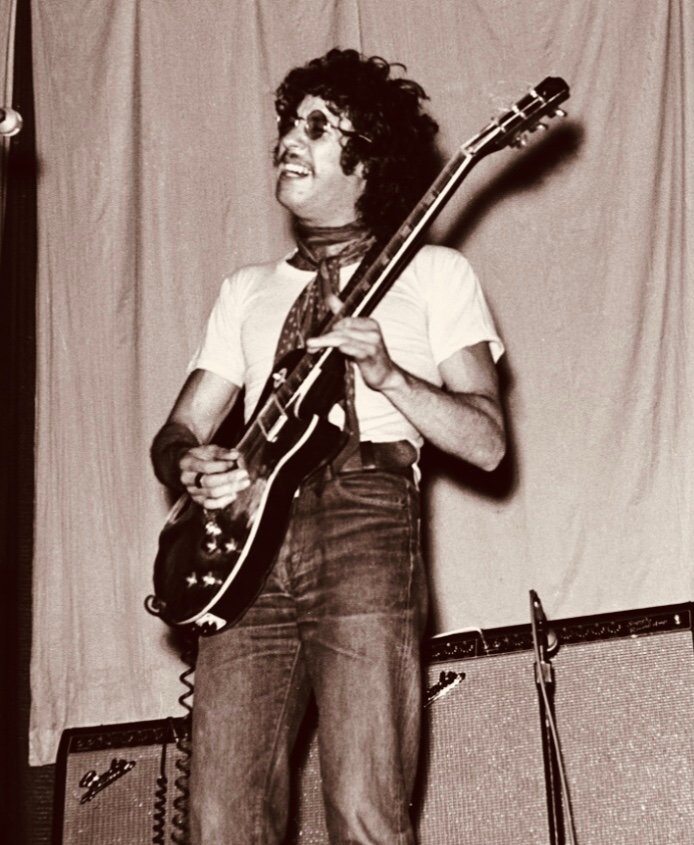
Peter Green of Fleetwood Mac, photo by Tom Wescher
Stone Crazy, Peter Green, Rod Stewart, Aynsley Dunbar, Jack Bruce
Korner’s influence extended beyond his own band. He played a vital role in launching The Rolling Stones, whose name was inspired by the 1950 Muddy Waters song Rollin’ Stone. The Stones took the blues and electrified it, turning it into a force that would soon dominate the world stage. Their early work, heavily rooted in American blues, was a major catalyst in popularizing the genre in Britain.
Korner was also instrumental in helping Paul Rodgers, one of the most remarkable vocalists in rock history, and his band Free gain traction in the late 1960s. Rodgers’ powerful, blues-infused voice would later become a defining element of Bad Company, a band that carried the blues-rock torch into the 1970s.
Someday Baby with Jeff Beck, Eric Clapton, John Mayal, Jimmy Page
Another towering figure in British blues was John Mayall, whose band, John Mayall’s Bluesbreakers, served as a launching pad for some of the greatest guitarists in history. Mayall himself was a talented musician, but his keen eye for guitarists is what made his band legendary. The Bluesbreakers lineup over the years featured an incredible roster of guitarists, including Eric Clapton, Peter Green, Mick Taylor, and even Roger Dean, who later became famous as a visionary album cover artist. Each of these players would go on to leave an indelible mark on rock and blues history.
I personally collected all of those Bluesbreakers albums and still treasure them to this day. The guitar work from that era remains some of the finest ever recorded, setting a standard that blues and rock guitarists still aspire to match.
As British blues evolved, it increasingly merged with rock and roll, giving rise to some of the most iconic music of the 20th century. No band embodied this fusion better than The Rolling Stones. They managed to blend blues authenticity with rock energy, earning them the title of England’s best blues band multiple times, according to New Musical Express(NME), a major British music publication.
Wake Up Mama, Ten Years After, Alvin Lee
I’ve always been amazed at how many legendary musicians passed through Alexis Korner’s orbit. His influence on British blues cannot be overstated. The guitarists who emerged from the British blues explosion—Jeff Beck (Passed away in 2023) Jimmy Page, Eric Clapton, Peter Green—are, in my opinion, the best of the best. It’s difficult to rank them, but each brought something unique to the table, helping to redefine what blues guitar could be.
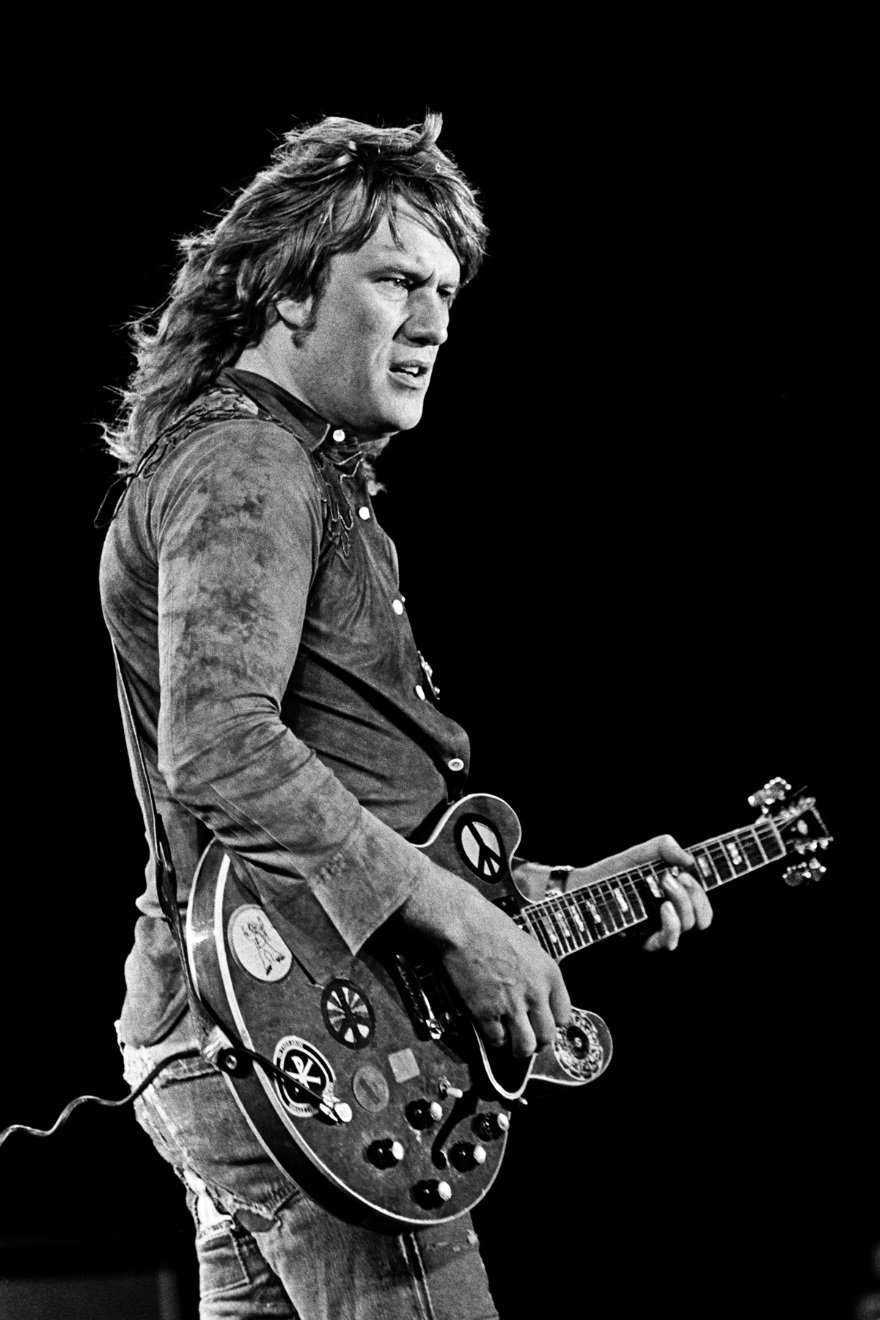
Alvin Lee of Ten Years After, photo by Tom Weschler
The British music explosion of the 1960s, often referred to as The British Invasion, saw bands like The Beatles, The Rolling Stones, The Dave Clark Five, The Yardbirds, The Animals, Gerry and The Pacemakers, The Hollies, The Kinks, The Animals, and many others took the U.S. by storm. While some leaned more toward pop, many had strong blues influences in their early work. The Yardbirds, in particular, helped bridge the gap between blues and rock, producing some of the greatest guitarists in history, including Clapton, Beck, and Page.
Confessin’ the Blues by the Rolling Stones
Just because the blues was born in America doesn’t mean it didn’t develop a British accent. The British took the genre, added their own twist, and gave it back to the world in a new form, ensuring that blues music would continue to evolve and inspire generations to come.
My Encounter With Jimmy Page and the Yardbirds
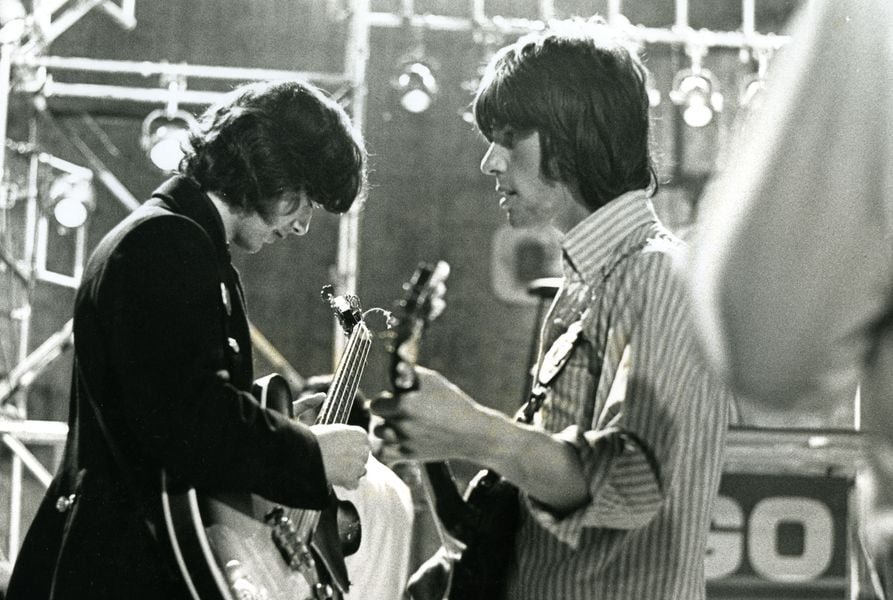
Jimmy Page and Jeff Beck
In the fall of 1966 I was working at Artist’s Music, a very well appointed music store with three outlets in Detroit and it’s suburbs. My job was the company truck driver. I was told to take three Vox Super Beatle amplifiers to the Coliseum and set them up for a performance by The Yardbirds.
That group was one of my favorites and as excited as I was the task at hand made me a little nervous. The store owner Vic Mushro came to the show and told me in no uncertain terms not to let the band turn the amps up all the way. My reply was “yes sir”.
Steeled Blues the Yardbirds
At the beginning of their set The Yardbirds took the stage, Jimmy Page was the only guitar player because Jeff Beck had left the band and went home to England. Jimmy came right up to me while I was standing behind his amp he had his Fender Telecaster with him. He said to me in a strong English accent: “Hello Mate” and proceeded to turn all the pots (volume dials) to ten!
I looked back at Vic and gave him a thumbs up. Then crossed my fingers and hoped the amp wouldn’t blow! It didn’t and relief came over me!
My Encounter With Eric Clapton and Cream
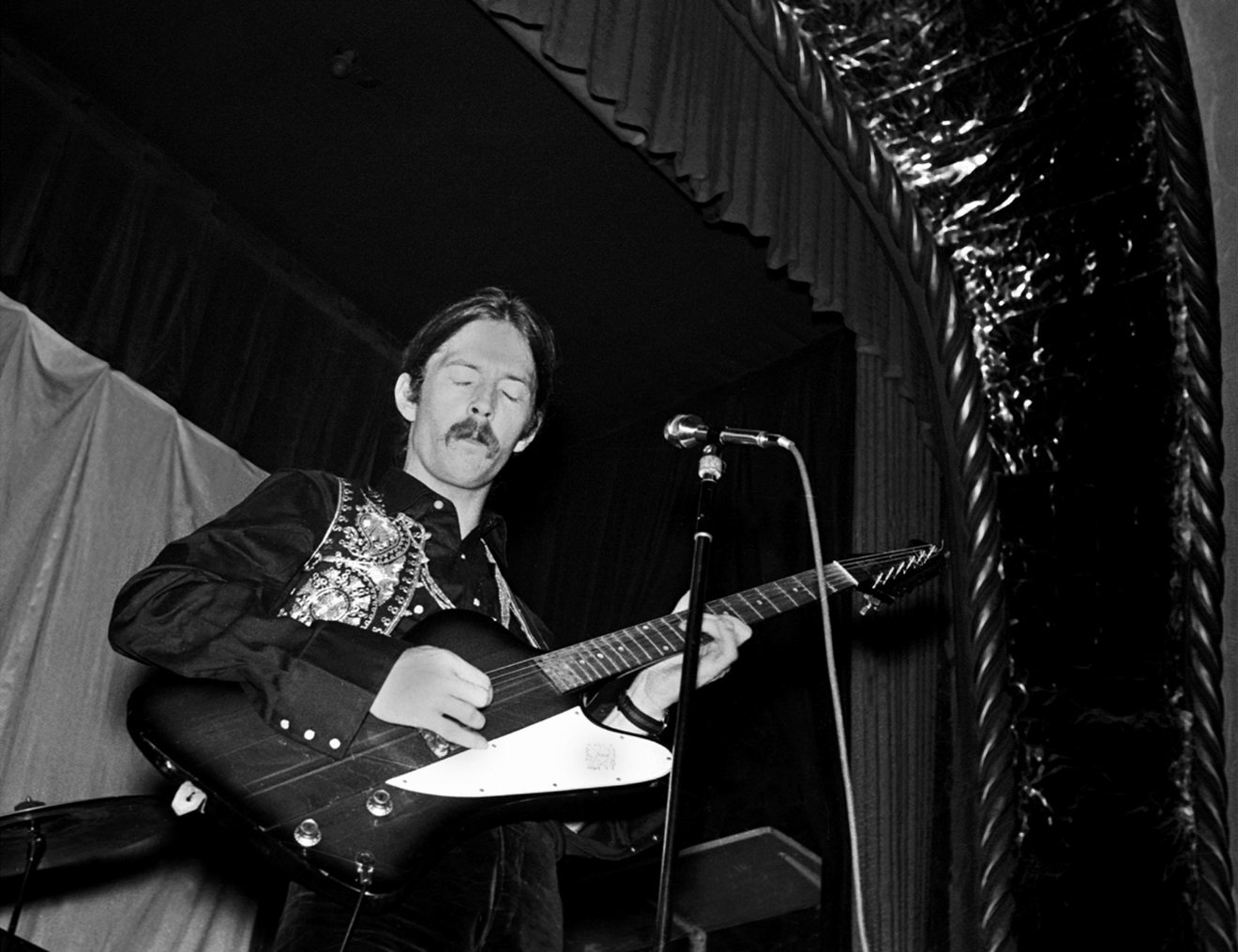
Eric Clapton, Tom Weschler photo
I was driving down to Olympia Stadium in Detroit to see Cream’s last show before they disbanded in October, 1968. On my way in the afternoon (I wanted to get there early) I was driving on Second Ave. just south of Grand Blvd. Where the very low bridge at Milwaukee St. passed over Second. I noticed an Avis rental truck under that overpass, stuck. I slowed down and asked one of the guys who was out letting air out of the tires if I could help. He asked me in an English accent, if I knew how to get to Olympia Stadium. I figured it had to be Cream’s equipment truck and helped them take some air out of one of the tires. Then told them to follow me. We proceeded to a gas station to fill the tires back up and went on to Olympia. When we got there I pointed to the back stage rollup door and started to drive toward the parking lot. Jerry, one of the roadies said to follow them into the building. I did and was thrilled that I got to park free right in the Stadium’s loading zone.
I helped Jerry and Mick to unload the Marshall amps and drums and take them to the back of the stage, which was in the center of the floor.
After that they asked me if I wanted a beer and took me to the dressing room where Eric Clapton was tuning his guitar. Jack Bruce was there talking to a couple of girls and Ginger Baker was fiddling with his drumsticks. I had a beer after being introduced to the band members as the guy who helped them with their earlier low bridge dilemma.
Little Brown Bird with Jeff Beck and Eric Clapton
When the doors opened I went out to where the crowd was gathering, it was a sold out show and thousands were there when I took a photograph of the ‘scene’. It was incredible. The place was filled with smoke from cigarettes and weed and in the distance on the center placed stage I could read the stenciled word CREAM on the back of the amps.
Back in the dressing room it was time for the show to begin. Eric asked me if I could take some photographs of them walking toward the stage, I did that and then parked myself right in front of the stage to shoot the show. As I got there, LB, one of the promoter’s staff, gave me a chair way in front of the front row. I felt special sitting there with nothing between the band and me.
The band was very good, I had seen them often at The Grande Ballroom but this was a much larger venue and the crowd didn’t seem to mind the round stage in the middle of the arena, a good time was had by all.
My Encounter With Robert Plant
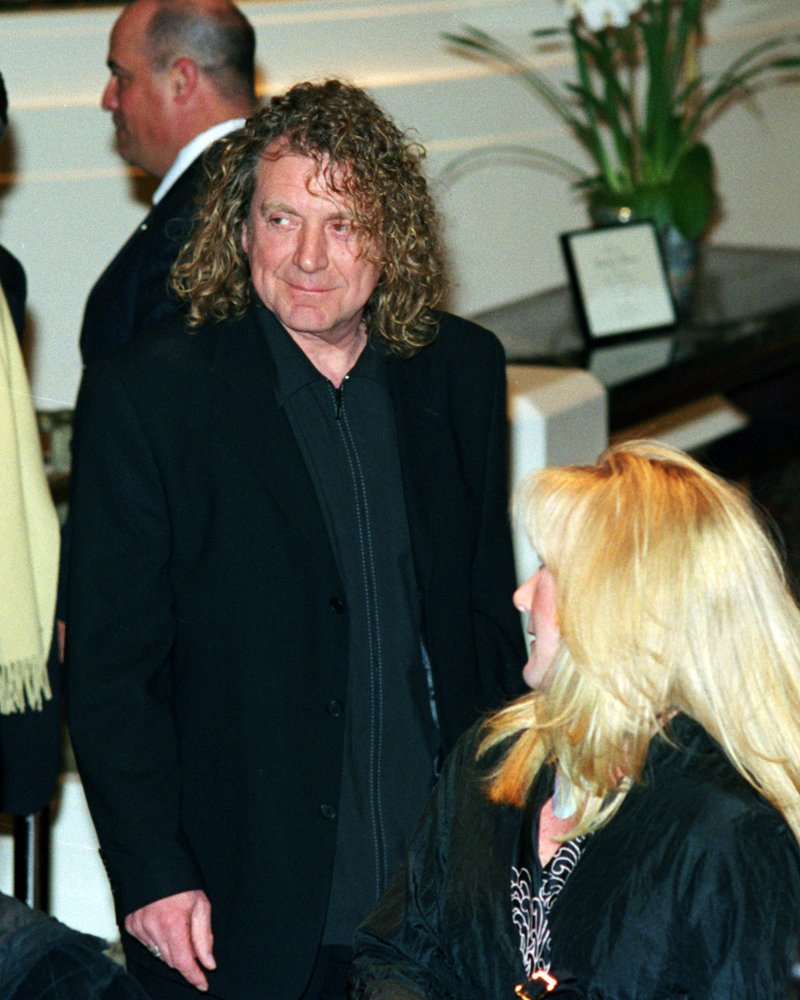
Robert Plant, Tom Weschler photo
On the road with Bob Seger in July 1969 the band had a few days off. Rather than drive home then back to Chicago again we decided to stay at the Lakeshore Holiday Inn in downtown Chicago so we could go catch some live music. Ace (one of my roadies) and I decided to go to see Led Zeppelin at the Kinetic Playground. Bob said he was going to go see Jefferson Airplane at the Aragon Ballroom.
We arrived at the Playground in time to catch Jethro Tull who was on tour with Led Zeppelin. I brought my cameras and shot a few pics of Jimmy Page and Robert Plant. Ace spotted some girls and asked me to take some pics of them instead of more of the bands so I did. Never having seen Jimmy Page’s new group, I was duly impressed, they were better than the Yardbirds, a band Page was in the year before that I had set up equipment for at the Michigan State Fairgrounds.
Back at the Holiday Inn after the show I went to the lobby to get some smokes out of the machine there and Robert Plant was standing in front of it looking at his hand full of change. He asked me if he had enough to buy some Marlboros, not being familiar with American change just yet. I told him no he didn’t but then gave him a quarter, which made it so he could get what he wanted. “Thank you mate” is what he said to me he got his smokes and walked off.
Traveling Riverside Blues, Led Zeppelin, Jimmy Page, Robert Plant, John Bonham, John Paul Jones
Over the next few years I ran into Robert a few times and jokingly said: “Robert, you got my quarter?” He laughed each time
In 2010 Robert Plant was coming to Detroit to help promote the Cadillac 100th Anniversary because GM had used one of their songs in Caddy spots on radio and TV. I was hired by WCZY, the co-sponsor of this event at the RenCen in Downtown Detroit to photograph the goings on
A large black Cadillac pulled up out front of the event and out came Robert Plant who looked directly at me and with the small Sony video camera he had he started to shoot a video of me with my camera pointed at him. We said hello and he asked what the interest was up to now on the quarter I lent him back in 1969. Funny but so true.
Stevie’s Blues, Spencer Davis Group, Steve Winwood
My Encounter With Jeff Beck
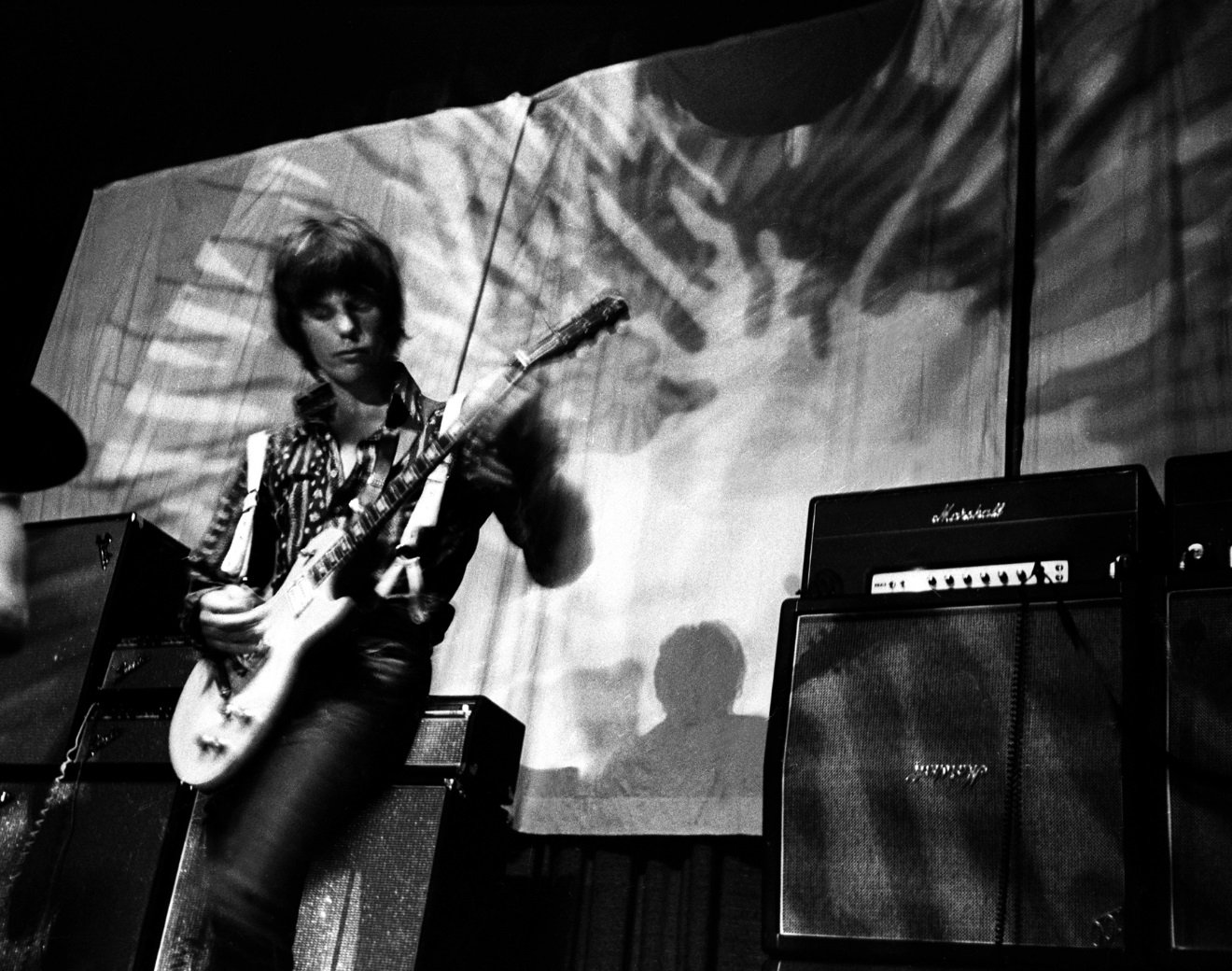
Jeff Beck, Tom Weschler photo
I was off the road for a few days because Bob Seger (I was his road manager at the time) was in the studio. Two friends and I went to see and record The Jeff Beck Group at The Grande. We used my Panasonic cassette player, not the best device for recording a loud band but it did work. We got 35 minutes of the show with Rod Stewart, Ronnie Wood, Nicky Hopkins and Tony Newman with the fabulous Jeff Beck on tape.
I took our BASF cassette tape to the studio where Bob was recording and after the session with Bob, I asked the engineer, Greg Miller to see if he could fix the sound up a bit. He sure did. Greg transferred it to a 7” reel and gave me a copy. I took it home and made several cassettes out of that tape. It sounded very good almost like a record. Not exactly like a record but almost, good enough for me to take it to Jeff Beck the next time he came to town.
We didn’t get to see Jeff Beck until the early ‘70s when he played at Ford Auditorium in Detroit. Jerry and I went to the venue early and got to the back stage area where we found Jeff in the dressing room. Politely we asked if we could give him a copy of a tape we made of him back in 1969. He laughed and said sure you can. We did and he immediately put it in a tape player he had, played it and told us: “this can’t be me, it’s too good” while laughing. Then he actually tried to figure out one of his licks on the tape. He said this was made before the car accident. Jeff was in an accident in England in Nov. 1969 and it messed up his playing for a while. We stayed for the show. Obviously he was back and better than ever!
Blues Deluxe Jeff Beck Group with Rod Stewart
Prominent British Blues Bands, 1960s and ‘70s
Blues Incorporated, 1961-66, Alexis Korner, Jack Bruce, Charlie Watts, Ginger Baker
The Rolling Stones, 1962-present, Mick Jagger, Keith Richards, Charlie Watts, Brian Jones, Bill Wyman, Ronnie Wood, Mike Taylor, Ian Stewart
The Animals, 1962-69, Eric Burdon, Alan Price, Chas Chandler, Hilton Valentine, John Steel
Bluesbreakers, 1963-70, John Mayall, Jack Bruce, Eric Clapton, Peter Green, Mick Taylor, Aynsley Dunbar, John McVie, Mike Fleetwood
The Yardbirds, 1963-68, Eric Clapton, Jeff Beck, Jimmy Page, Robert Plant, Keith Relf, Jim McCarty, Chris Preja, Paul Samwell-Smith
Spencer Davis Group, 1963-74, Spencer Davis, Steve Winwood, Pere York, Muff Winwood
Graham Bond Organization, 1963-70, Graham Bond, John McLaughlin, Jack Bruce, Ginger Baker
The Birds, 1964-67, Ronnie Wood, Ali McKenzie, Tony Munroe, Kim Gardner, Pete McDaniels
Savoy Brown, 1965-2022, Kim Simmonds, John O’Leary, Brice Pertius, Trevor Jeavons, Ray Chappell, Leo Manning
Chicken Shack, 1965-2022, Ki Simons, Paul De Salvo, Garnet Grimm
Small Faces, 1965-69, Steve Marriott, Ronnie Lane, Kenny Jones, Ian McLagen
Ten Years After, 1966-82, Alvin Lee, Leo Lyons, Ric Lee, Chick Churchill
Cream, 1966-68, Eric Clapton, Jack Bruce, Ginger Baker
Jeff Beck Group, 1967-72, Jeff Beck, Rod Stewart, Aynsley Dunbar, Ronnie Wood
Fleetwood Mac, 1967-95, Peter Green, Mike Fleetwood, Stevie Nicks, John McVie
Traffic, 1967-74, Steve Winwood, Jim Capaldi, Chris wood, Dave Mason
Jetro Tull, 1967-2011, Ian Anderson. Mick Abrahams, Glenn Cornick, Clive Baker, Martin Barre
Led Zeppelin, 1968-82, Jimmy Page, Robert Plant, John Bonham, John Paul Jones
Free, 1968-73, Paul Rogers, Paul Kassoft, Andy Fraser, Simon Kirke
Climax Blues Band, 1968-84, Colin Cooper, Pete Haywood, Derek Holt, Richard Jones, George Newsome, Arther Wood
Blodwyn Pig, 1968-70, Mick Abrahams, Jack Lancaster, Andy Pyle, Ron Berg
Blind Faith, 1969, Eric Clapton, Steve Winwood, Ginger Baker, Ric Grech
Humble Pie, 1969-75, Steve Marriott, Peter Frampton, Greg Ridley, Jerry Shirley
Faces, 1969-75, Rod Stewart, Ronnie Lane, Keny Jones, Ian McLagen, Ronnie Wood
Foghat, 1971-85, Dave Peverett, Tony Stevens, Roger Earl, Rod Price
Bad Company, 1973-82, Paul Rodgers, Simon Kirke, Mick Ralphs, Boz Burrell